.png&w=384&q=75)
Introduction
Tribological properties of drilling fluids, their ability to reduce friction and wear, are essential for ensuring smooth drilling tool rotation during the construction of deep oil wells [1], as well as during pilot hole drilling in horizontal directional drilling (HDD) technology of pipeline installation [2, p. 162-173]. When fluids possess ineffective tribological characteristics, practical drilling operations face immediate consequences. Poor lubrication leads to elevated torque and drag, which restricts weight transfer to the drill bit and reduces rate of penetration. This accelerates wear on drill bit, drill string, and other rock cutting tools, thereby increasing non-productive time of drilling operations. Higher energy consumption from frictional losses raises operational costs, while inadequate film strength increases the risk of differential sticking, potentially leading to costly fishing operations or wellbore loss. Therefore, optimizing fluid compositions is critical. This study investigates polymer-based and polymer-clay drilling fluids using the Russian ИИ 5018 friction test device [3, p. 10; 6, p. 7], evaluating how lubricant concentration affects friction coefficients and wear rates. Standardized steel specimens ensure any performance differences are attributed to fluid properties, supporting more reliable lubricant selection for harsh directional drilling conditions.
The “metal-metal” pair were produced according to GOST 9941-2022 by PAO TMK company [4, p. 19; 8, p. 24]. Procedures and other studies on how the device ИИ 5018 works are in [3, p. 10; 5, p. 44-48; 6, p. 7; 7, p. 19-27].
Table
Contents of drilling fluids and additives/lubricants
Drilling fluid and lubricant | Reagents/additives | Quantity, g | Purposes | |
Polymer-clay drilling fluid | NaOH | 25 | pH controller | |
Bentonite powder | 150 | Structure-forming | ||
Xanthan gum | 150 | Structure-forming | ||
H2O | 1000 | To increase viscosity, control fluid loss, and improve cuttings | ||
Flodrill PAM | 15 | Slurry hydration and dispersing inhibitor | ||
Polymer drilling fluid | NaOH | 25 | pH controller | |
Xanthan gum | 300 | Structure-forming | ||
Flodrill PAM | 15 | Slurry hydration and dispersing inhibitor | ||
H2O | 1000 | To increase viscosity, control fluid loss, and improve cuttings | ||
Drilling fluid lubricant | Sunflower cooking oil | |||
Results
Figure 1 illustrates that for the polymer-clay drilling fluid, increasing the specific load consistently leads to a percentage reduction in the friction coefficient across all lubricant concentrations. The 3% lubricant additive provides the most significant friction reduction, particularly at higher loads. Figure 2 demonstrates a similar trend for wear rate reduction in the polymer-clay fluid, where higher loads and increased lubricant percentages result in progressively good wear protection, with the 3% concentration again showing a good performance. Figure 3 reveals that the polymer-based drilling fluid achieves superior friction reduction compared to the polymer-clay formulation. The percentage decrease in friction coefficient improves with increasing load, and the 3% lubricant concentration consistently outperforms lower concentrations. Figure 4 confirms that wear rate reduction follows the same pattern, with the polymer fluid containing 3% lubricant showing the most substantial wear protection across all load conditions, confirming the enhanced lubricating properties of polymer-based systems.
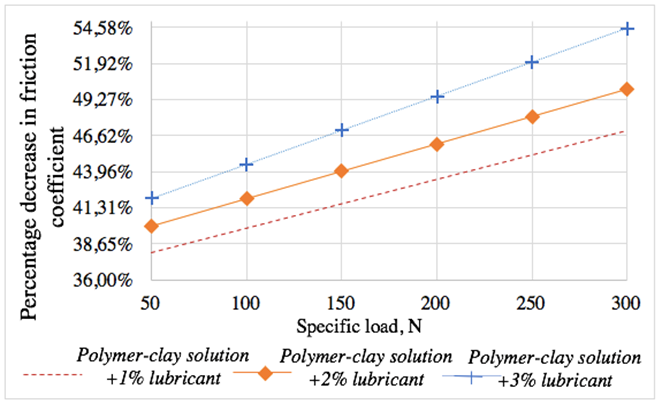
Fig. 1. Line graph for the percentage decrease in friction coefficient on specific load basing on different percentages of lubricants added to polymer-clay based mud
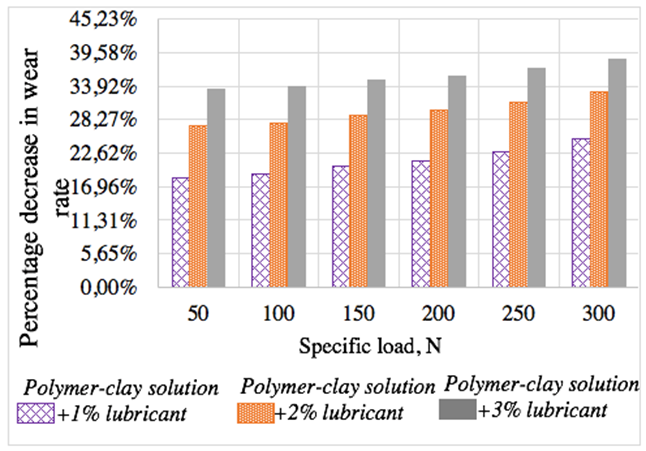
Fig. 2. Bar graph for the percentage decrease in wear rate on specific load basing on different percentages of lubricants added to polymer-clay based mud
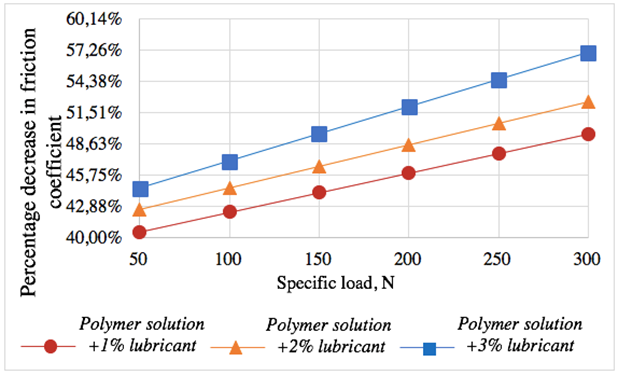
Fig. 3. Line graph for the percentage decrease in friction coefficient on specific load basing on different percentages of lubricants added to polymer based mud
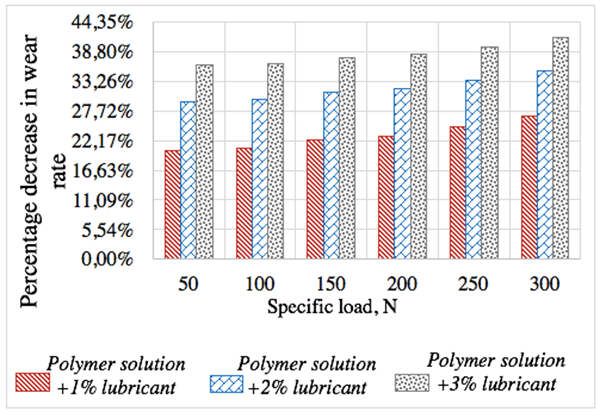
Fig. 4. Bar graph for percentage decrease in wear rate on specific load basing on different percentages of lubricants added to polymer based mud
Discussions
The experimental results demonstrate a clear correlation between lubricant concentration and improved tribological performance in both drilling fluid formulations. The polymer-based drilling fluid consistently exhibited superior friction reduction and wear resistance compared to the polymer-clay fluid, which can be attributed to its lower solid-phase content. Reduced solid particles in the polymer fluid minimize abrasive interactions at the “metal-metal” pair interface while promoting formation of a more stable and continuous lubricating film. The increasing percentage reductions in friction coefficient and wear rate with higher specific loads indicate that the lubricant film becomes more effective under greater contact pressures, suggesting load-activated lubrication mechanisms. Sunflower cooking oil as a lubricant additive demonstrates remarkable effectiveness, achieving nearly 50% friction reduction at 3% concentration in some load conditions. This performance likely results from the oil's polar molecules forming a durable adsorbed layer on metal surfaces, effectively separating the contacting surfaces and reducing direct “metal-metal” pair contact. The consistent improvement across all load ranges confirms the lubricant's versatility for varying downhole conditions.
Conclusions
This experimental investigation confirms that lubricant concentration critically influences the tribological properties of drilling fluids. Increasing sunflower oil additive to 3% reduced the friction coefficient by approximately 47% compared to base fluids without lubricant, demonstrating the essential role of proper lubrication in drilling operations. The polymer-based drilling fluid consistently outperformed the polymer-clay formulation, exhibiting lower friction coefficients and wear rates across all test conditions due to its reduced solid-phase content and enhanced film-forming characteristics. These findings have significant practical implications for drilling operations, particularly in extended-reach and directional wells where torque and drag present major challenges. The 3% lubricant concentration emerges as the optimal formulation among tested samples, providing maximum tribological benefits while maintaining practical additive volumes.
Future research should investigate long-term stability of these lubricating properties under elevated temperatures and pressures, as well as evaluate alternative biodegradable lubricants for environmentally sensitive drilling applications.
.png&w=640&q=75)