.png&w=384&q=75)
Introduction
Drilling fluid lubrications are crucial for reducing torque, drag, and mechanical wear in downhole conditions. Poor lubrication increases friction, accelerates tool wear, and causes instability [5, p. 12]. Therefore, laboratory tribological testing was necessary to evaluate how fluid composition and additives affect friction and wear under simulated field conditions. This study evaluates the tribological behaviour of water-based, clay-based, and biopolymer-based drilling fluids using the ИИ 5018 installation [6, p. 7]. It determines how 0.5%–1.5% lubricating additives influence friction coefficient, wear rate, and boundary-film formation, aiming to identify the most effective formulation for drilling tool surface protection and stability.
Three tasks were performed: experimental determination of friction coefficients under controlled specific load and speed; measurement of steel specimen (labelled “1” in figure 1) wear by mass loss; and analysis of the relationship between fluid composition, additive concentration, friction coefficient, and wear rate. By simulating downhole mechanical loading, the study compares lubrication efficiency and identifies the optimal drilling fluid system for minimizing friction and wear. More similar studies conducted in the articles [1, p. 18; 3, p. 1066-1068; 4, p. 40-43].
Steel roller samples “1” specifications: hardness of 35 HRC; steel material of 40ХН (written in Russian); coating diameter of 50 mm; surface roughness of ; surface coating А, В – Х.36 б ГОСТ 9.301-86 (written in Russian); and thickness of 0,011 m [2, p. 51]. Steel roller samples “2” specifications: according to ГОСТ 9.301-86 (written in Russian); yield strength ‒ (379…552); tensile strength of 655; Elongation at break 15% [2, p. 51].
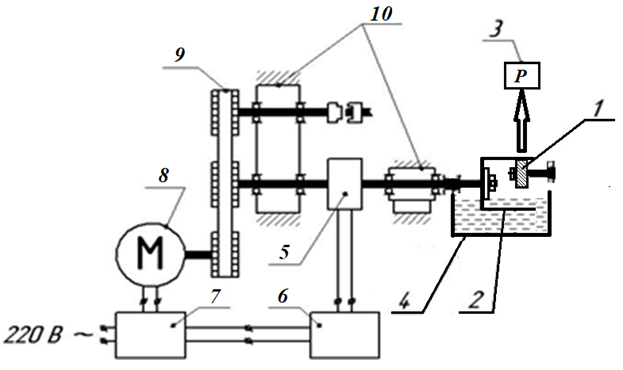
Fig. 1. The Modernized installation ИИ 5018 [6, p. 7]
The operating principle of installation ИИ 5018: The device operates on a 220 V eclectic power, a dedicated software program on computer 6 transmits a control signal to the thyristor drive 7, which regulates electric motor 8 and maintains the required rotational speed. The motor’s rotation is conveyed to the lower steel pipe specimen 2 via the belt transmission 9 and the torque sensor 5. At the same time, steel specimen 1 is pressed against it with a predetermined load P by means of the loading assembly 3. The resulting friction torque is measured by torque sensor 5 and sent back to the computer for recording, 4 is the drilling fluid container, and 10 is the shaft bearing supports [6, p. 7].
Compositions of the initial biopolymer-based mud: water of 800g; xanthan gum of 200g. sodium carbonate of 5g; sodium hydroxide of 8g; starch of 50g; and chalk of 15g. Compositions of the initial clay-based mud: water of 700g; bentonite clay powder of 300g; sodium carbonate of 5g; sodium hydroxide of 8g; starch of 50g; and chalk of 15g. Compositions of the water-based mud: water of 1000 g; sodium carbonate of 5g; sodium hydroxide of 8g; starch of 50g; chalk of 15g. Compositions of the lubricating additive: tallow oil of 25g.
Results
Figure 2 illustrates the dependence of the friction coefficient on specific load for water-based, clay-based, and biopolymer-based drilling fluids with varying lubricant concentrations. The graph shows a general increase in friction coefficient with increasing specific load. Water-based mud exhibits the highest friction coefficient values across all loads. Clay-based and biopolymer-based drilling fluids demonstrate significantly lower friction coefficient, with further reduction observed after adding 0.5–1.5% lubricant. Biopolymer-based mud enriched with 1.0–1.5% lubricant display the lowest and most stable friction coefficients, confirming improved protective-film formation under loading conditions.
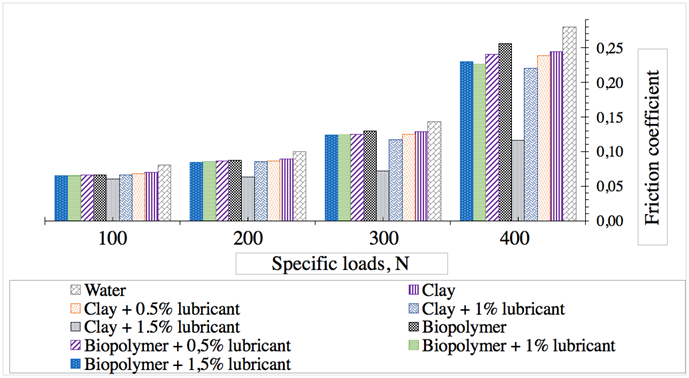
Fig. 2. The dependence of friction coefficient on specific load for all mud specimens
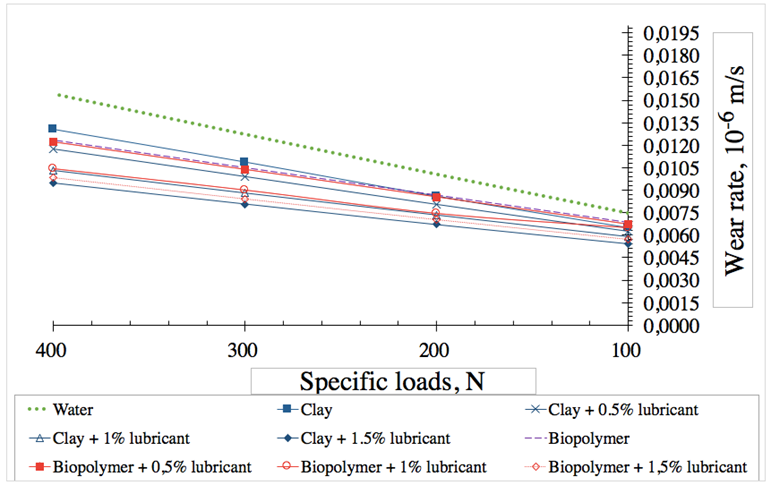
Fig. 3. The dependence of wear rate on specific load for all mud specimens
Figure 3 presents the dependence of wear rate on specific load for the tested drilling fluids. Wear increases with load for all systems; however, the magnitude differs significantly. Water-based mud produces the highest wear rate due to poor film formation. Clay-based drilling fluids reduce wear moderately, while biopolymer-based mud show superior wear resistance. The addition of 1.0–1.5% lubricant significantly decreases wear rate, particularly in biopolymer-based mud, indicating enhanced anti-wear protection and stronger boundary-layer stability.
Discussion of results
The results in figures 2 and 3 demonstrate a clear correlation between fluid composition and tribological performance. Water-based mud consistently produced the highest friction and wear across all loads due to inadequate film formation. Lubricant addition systematically improved performance for all fluid types. Biopolymer-based mud with 1.0–1.5% lubricant exhibited the lowest and most stable friction coefficients (fig. 2) and minimal wear rates (fig. 3), confirming that enhanced boundary-film strength provides superior protection against "metal-metal" contact under increasing load.
Conclusions
According to the experimental investigations, clay-based drilling fluids showed superior performance, achieving significantly lower friction coefficients and wear rates compared to both water-based and biopolymer-based drilling fluids. The addition of 1.0–1.5% lubricant further enhanced clay-based drilling fluid performance, producing the most stable frictional response and minimal material loss under increasing contact pressures. This confirms that clay particles, when combined with lubricating additives, create robust boundary films that effectively separate “metal-metal” pairs.
Biopolymer-based drilling fluid, while demonstrating improvement over water-based drilling fluid, did not match the tribological performance of clay-based drilling fluid. Their friction reduction and wear protection were comparatively lower, particularly under higher specific loads where film stability diminished.
Therefore, clay-based drilling fluid enriched with 1.0–1.5% lubricant emerges as the most effective drilling fluid formulation for minimizing friction and wear in drilling operations, offering superior surface protection and operational reliability.
.png&w=640&q=75)