.png&w=384&q=75)
1. Introduction
With the deep integration of technologies such as artificial intelligence, big data, and the Internet of Things into the field of education, smart education has become a core direction of modern educational development. Characterized by personalization, intelligence, and interactivity, it breaks the temporal and spatial constraints of traditional education and provides learners with flexible and efficient learning pathways [1, p. 38]. The widespread adoption of online learning and blended learning models enables learners to plan their learning progress more autonomously. At the same time, however, it has also brought about prominent mental health issues, including learning-related loneliness, distraction, academic anxiety, and learning burnout. These negative psychological states not only reduce learning efficiency and engagement but may also affect learners’ physical and mental well-being if accumulated over time [2, p. 74].
Traditional methods for monitoring learners’ psychological states mainly rely on questionnaires, teachers’ subjective observations, and similar approaches. These methods suffer from strong time lag, high subjectivity, and limited coverage, making them difficult to adapt to the real-time, large-scale, and precise monitoring demands of smart education[3,l.68]. Based on this, the present study focuses on smart education scenarios and proposes an AI-based method for learner psychological state recognition and early warning.
2. Review of Related Studies at Home and Abroad
In recent years, a large number of studies have been conducted by scholars both in China and internationally on monitoring learners’ psychological states in educational settings. In terms of data sources, existing research has mainly focused on single-dimensional data. Some studies have used learning behavior data, such as login duration, assignment submission, while others have identified emotional states based on physiological features such as facial expressions and voice signals [4, p. 58.].
In terms of recognition models, traditional machine learning algorithms, such as Support Vector Machines (SVM), Decision Trees, and K-Nearest Neighbors (KNN), have been applied to psychological state classification. However, their ability to extract complex nonlinear features is limited, and their recognition accuracy is often insufficient to meet practical needs [5, p. 90].
3. AI-Based Method for Learner Psychological State Recognition and Early Warning
The overall method proposed in this paper consists of three modules: multi-source feature collection and representation, a psychological state recognition model, and a dynamic early warning mechanism. The overall framework is shown in figure 1.
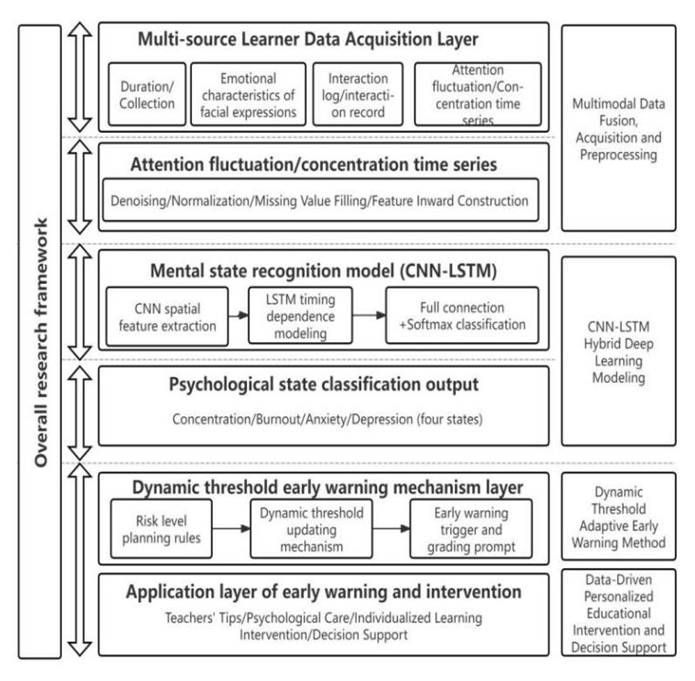
Fig. 1
3.1. Multi-Source Psychological Feature Collection and Representation
To comprehensively characterize learners’ psychological states, this study collects three types of multi-source data: behavioral features, physiological features, and interaction features.
Behavioral features: learning duration, login frequency, assignment completion rate, time spent on specific knowledge points, and number of learning interruptions;
Physiological features: facial expressions collected through a camera (e.g., happiness, fatigue, anxiety, and concentration) and attention fluctuation values;
Interaction features: number of question-and-answer interactions on the platform, number of resource clicks, and frequency of teacher-student and student-student communication.
The collected raw data are preprocessed through normalization, denoising, and missing-value imputation to construct standardized feature vectors, thereby forming a psychological state feature representation system that provides high-quality data input for subsequent model training.
3.2. Psychological State Recognition Model Based on CNN-LSTM
This paper adopts a deep learning model that integrates CNN and LSTM to achieve accurate classification of psychological states.
CNN module: extracts spatial features from the preprocessed multi-source data, explores the hidden correlations among behavioral, physiological, and interaction data, and outputs a high-dimensional spatial feature matrix.
4. Experimental Design and Result Analysis
4.1. Experimental Data and Environment
The experiment selected 150 learners from a smart education platform as the research subjects and collected 2,000 valid sample datasets. The data were divided into a training set and a test set at a ratio of 7:3. The experimental environment was based on Python 3.8 and the TensorFlow 2.0 framework, with hardware configuration including an Intel i7 processor and 16 GB of memory.
4.2. Evaluation Metrics
Accuracy, Precision, Recall, and F1-score were adopted as the evaluation metrics for the model. At the same time, the false alarm rate and response time of the early warning system were also recorded.
4.3. Results and Analysis
The experimental results show that the proposed method achieved an accuracy of 91.6% in psychological state recognition, with a precision of 90.8%, a recall of 91.2%, and an F1-score of 91.0%, outperforming single SVM, CNN, and LSTM models. The average warning response time was 1.2 seconds, and the false alarm rate was only 4.3%, demonstrating both real-time capability and reliability.
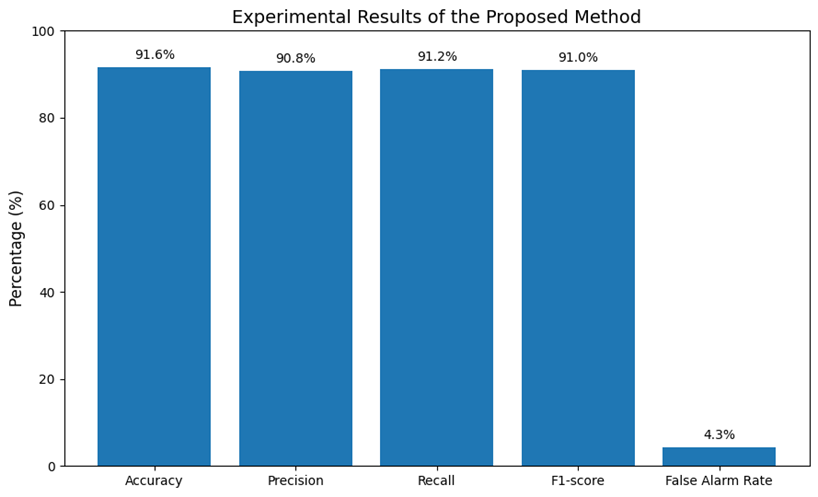
Fig. 2
Comparative experiments further indicate that, compared with single behavioral features, multi-source feature fusion improved recognition accuracy by 15.7%. Compared with fixed-threshold mechanisms, the dynamic threshold mechanism reduced the false alarm rate by 9.6%, thereby verifying the effectiveness of the proposed method.
5. Conclusion and Future Prospects
This paper proposes an AI-based method for learner psychological state recognition and early warning in smart education scenarios. Experimental results demonstrate that the proposed method has high recognition accuracy, fast warning response, and a low false alarm rate, and can effectively support the monitoring and intervention of learners’ mental health.
.png&w=640&q=75)