.png&w=384&q=75)
1. Introduction
In recent decades, internationalization has become one of the central trends in higher education development. It reflects the integration of international elements into educational systems, including academic mobility, joint programs, and research cooperation [1, p. 277].
China and Kazakhstan, as neighboring countries with close economic and political ties, have actively developed cooperation in education. This cooperation plays an important role not only in training specialists but also in strengthening cultural and scientific exchange [2, p. 41].
The purpose of this paper is to analyze the current state of educational cooperation between China and Kazakhstan and to identify its main development trends in the context of higher education internationalization.
2. Literature Review
The internationalization of higher education has been widely studied in academic literature. It is generally understood as the integration of international and intercultural elements into teaching and research activities [1, p. 278].
Many studies emphasize that internationalization is closely related to student mobility, institutional cooperation, and academic exchange. In this context, cross border education plays an important role in improving the competitiveness of universities.
Research on Central Asia shows that Kazakhstan actively promotes international cooperation in education, while China has expanded its global educational presence by attracting international students and developing partnerships [3, p. 96; 4, p. 58].
At the same time, some scholars point out that cooperation between China and Kazakhstan is still mainly focused on student mobility, while deeper academic collaboration remains limited [5, p. 74].
3. Current State of Educational Cooperation
To better understand the characteristics of bilateral cooperation, it is necessary to examine its current state from several key dimensions, including institutional interaction, student mobility, and research collaboration.
3.1. Institutional Interaction
Educational cooperation between China and Kazakhstan is supported by bilateral agreements and intergovernmental programs [2, p. 43]. These agreements create a foundation for joint educational initiatives and academic exchange.
Universities in both countries have established partnerships that include exchange programs and joint training activities. In recent years, there has been a gradual shift toward more structured cooperation, although the level of integration remains uneven.
3.2. Student Mobility
Student mobility is one of the most dynamic and visible aspects of China Kazakhstan educational cooperation. In recent years, the number of Kazakhstani students studying in China has shown a steady increase, reflecting both policy support and growing educational demand [3, p. 99].
One of the main factors contributing to this trend is the availability of scholarship programs, which significantly reduce the financial burden for students. In addition, relatively affordable tuition fees and simplified admission procedures make Chinese universities more accessible.
Another important factor is the diversification of study programs. Students are increasingly choosing not only language programs but also degree programs in fields such as engineering, economics, and management. This indicates a shift from short term educational exchange to more long term academic engagement.
At the same time, student mobility also contributes to cultural exchange and mutual understanding between the two countries. However, certain challenges remain, including adaptation difficulties, language barriers, and differences in educational systems, which may affect students’ academic experience.
Table
Key Directions of Educational Cooperation
Direction | Main Features | Level of Development |
Student mobility | Exchange programs and degree studies | High |
Institutional cooperation | Agreements and partnerships | Medium |
Research collaboration | Joint projects and conferences | Developing |
3.3. Research Cooperation
Scientific research cooperation between China and Kazakhstan has gradually expanded in recent years, becoming an important complement to educational exchange. Joint academic conferences, research projects, and scholarly communication platforms have increased, providing opportunities for knowledge sharing and professional interaction [5, p. 76].
In particular, cooperation is more visible in applied research fields such as engineering, economics, and regional development, where both countries share common interests. Some universities and research institutions have begun to establish joint laboratories and research centers, although such initiatives are still limited in number.
At the same time, the level of co authored publications and long term collaborative projects remains relatively low. This indicates that research cooperation is still in a developing stage and has not yet reached a stable and systematic level. Strengthening institutional support and encouraging deeper academic collaboration will be essential for further development.
4. Challenges of Cooperation
Despite the positive progress achieved in recent years, educational cooperation between China and Kazakhstan still faces several challenges.
First, there is an imbalance in educational resources and institutional capacity. Differences in funding, infrastructure, and academic development levels affect the quality and effectiveness of cooperation [3, p. 118]. In some cases, this leads to unequal participation in joint programs and limits the potential for deeper collaboration.
Second, cooperation is still largely concentrated in student mobility, while other forms of interaction, especially joint research and academic production, remain underdeveloped. This reduces the overall depth and sustainability of cooperation.
Third, language and cultural differences continue to create barriers. Although language programs are expanding, communication difficulties and differences in academic traditions can affect the efficiency of cooperation and the quality of learning outcomes.
Finally, some cooperation projects lack long term strategic planning and stable institutional support. Without clear coordination mechanisms, certain initiatives remain formal and do not produce lasting academic results.
5. Development Trends
The future of China Kazakhstan educational cooperation will be shaped by several key trends.
Digital technologies will play an increasingly important role, enabling new forms of online and hybrid education. At the same time, cooperation will become more diversified, including research partnerships and innovation platforms.
In addition, deeper academic integration will be required, particularly in joint programs and research projects. Regional cooperation frameworks will further strengthen the international position of both countries.
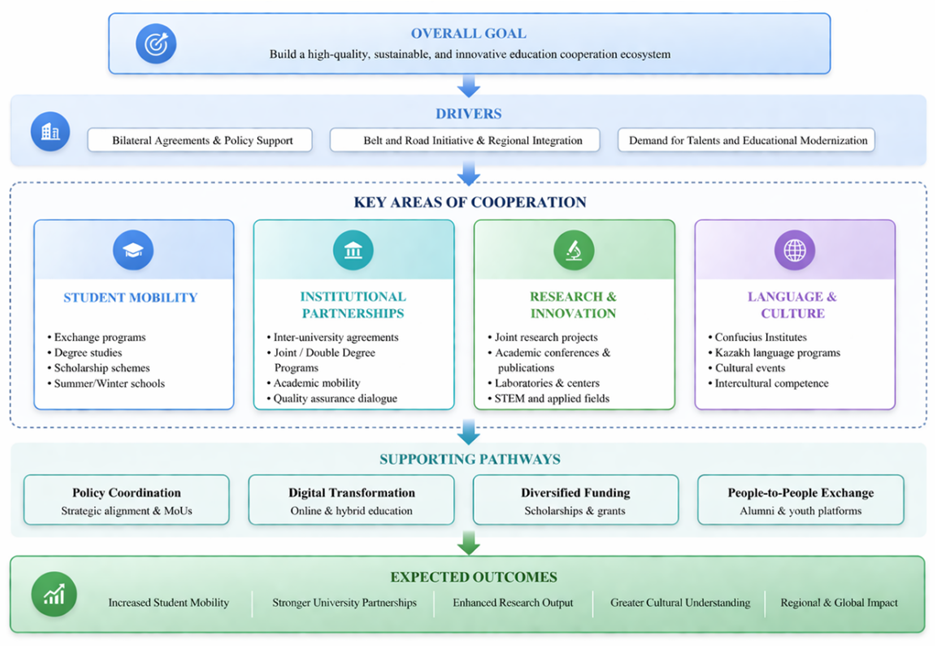
Fig. Development Model of Educational Cooperation
6. Conclusion
Educational cooperation between China and Kazakhstan has developed significantly, especially in the field of student mobility. At the same time, challenges related to structural imbalance and limited academic integration remain.
Future development will depend on strengthening institutional cooperation, expanding research interaction, and adapting to digital transformation. These steps will contribute to more sustainable and effective educational cooperation.
.png&w=640&q=75)