
In recent years, higher education has experienced significant changes driven by the growing demand for student-centered learning. Traditional teaching methods, focused mainly on knowledge transmission, often fail to ensure active participation, motivation, and strong academic performance. Therefore, there is an increasing need for innovative approaches that enhance student engagement. Collaborative learning has proven effective in promoting interaction, shared responsibility, and active involvement, while advancements in artificial intelligence offer new opportunities to create adaptive, personalized, and data-driven learning environments.
Despite the growing use of collaborative learning and AI in education, there is still a need for a comprehensive framework that integrates these approaches to better organize and manage students’ academic activity. This study aims to develop and evaluate a methodological approach that combines collaborative learning with diagnostic and motivational technologies on an AI-based platform. Collaborative learning, grounded in social constructivist theory, enhances engagement, performance, and critical thinking, while Vygotsky’s concept of the zone of proximal development highlights the importance of interaction with peers and instructors in achieving higher cognitive development.
In pedagogical research, collaborative and cooperative learning are often distinguished as related but conceptually different approaches. Cooperative learning is typically structured and teacher-directed, focusing on group goals and individual accountability, whereas collaborative learning emphasizes shared knowledge construction, learner autonomy, and active participation. These approaches play a significant role in developing higher-order thinking skills and improving academic outcomes.
Empirical studies confirm that collaborative learning has a positive impact on students’ academic performance and motivation. Research findings indicate that peer interaction, group engagement, and social factors significantly influence learning outcomes and academic achievement. Additionally, peer learning strategies promote active participation and enable students to benefit from diverse perspectives, thereby enhancing knowledge retention and understanding.
The integration of technology has further expanded the effectiveness of collaborative learning. Computer-mediated collaborative learning environments provide flexible and interactive opportunities for communication, problem-solving, and knowledge sharing among students. Moreover, recent studies emphasize the importance of both individual self-regulation and socially shared regulation in achieving effective collaborative learning outcomes.
Despite extensive research on collaborative learning and its benefits, there remains a lack of comprehensive methodological approaches that integrate collaborative learning with diagnostic and motivational technologies, as well as AI-based platforms. Addressing this gap is essential for improving the efficiency of organizing and managing students’ academic activity in higher education.
This study employs a mixed-method research design to investigate the effectiveness of organizing and managing students’ academic activity through collaborative learning supported by diagnostic and motivational technologies and enhanced by an AI-based platform. The research was conducted in a higher education institution involving undergraduate students.
The study involved experimental and control groups over one academic semester. The experimental group used collaborative learning supported by diagnostic tools, motivational strategies, and an AI-based platform, while the control group followed traditional methods. Students’ academic activity was assessed using criteria such as performance, participation, motivation, and collaboration, with data collected through questionnaires, observations, and academic results.
Statistical analysis was conducted using SPSS software. Descriptive statistics, correlation analysis, and comparative methods were applied to evaluate the effectiveness of the proposed approach. The relationship between collaborative learning, motivation, and academic performance was measured using correlation coefficients.
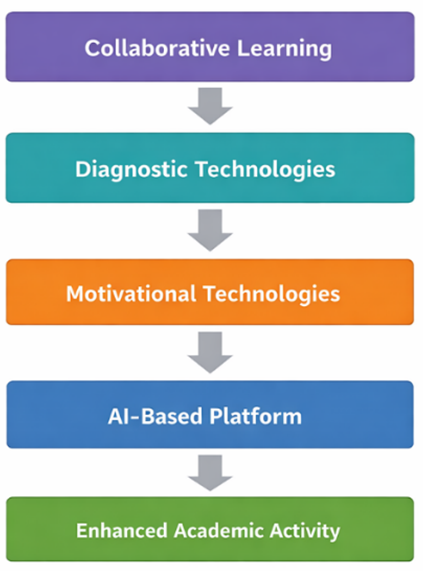
Fig. Methodological framework
The framework demonstrates how collaborative learning, diagnostic and motivational technologies, and an AI-based platform are integrated to enhance students’ academic performance and engagement.
An AI-based platform was used to support adaptive learning, track students’ progress, and provide personalized feedback, helping to optimize the learning process and enhance collaboration. The proposed framework integrates collaborative learning with diagnostic and motivational technologies, offering a systematic approach to improving the organization and management of academic activity. The results show that this approach significantly enhances students’ academic performance and engagement.
The analysis of the experimental and control groups showed clear differences in academic outcomes. Students in the experimental group demonstrated higher achievement, greater participation, and increased engagement, with motivation and involvement in collaborative tasks rising significantly. Statistical analysis using SPSS confirmed the effectiveness of the approach, revealing a positive correlation between collaborative learning, motivation, and academic performance (r ≈ 0.6). Additionally, diagnostic tools helped identify individual learning needs, enabling targeted motivational strategies that improved engagement and contributed to a more structured and effective learning process.
The implementation of the AI-based platform further improved the approach by enabling adaptive learning, personalized feedback, and continuous monitoring of students’ progress, leading to better performance, collaboration, and self-regulation. These results align with previous studies highlighting the positive impact of collaborative learning and technology integration, while also extending existing research through an integrated framework combining collaborative, diagnostic, motivational, and AI-based technologies. Overall, the study confirms that this approach significantly enhances students’ academic performance, engagement, and participation in higher education.
The statistical analysis confirmed a positive relationship between collaborative learning, motivation, and academic outcomes, while the AI-based platform further improved the organization of academic activity through adaptive learning and personalized feedback. The study emphasizes the importance of integrating modern technologies with student-centered approaches to create more effective and flexible learning environments. Overall, the proposed method provides a practical and efficient solution for enhancing academic activity in higher education across various contexts.
.png&w=640&q=75)