.png&w=384&q=75)
Introduction
Corporate business process automation is increasingly developing under conditions of heterogeneous data flows, regulatory change, fragmented application portfolios, and pressure to shorten the delivery time of digital solutions. In this environment, conventional custom development is often too slow, costly, and dependent on scarce engineering resources. As a result, intelligent no-code platforms (INCPs) are increasingly viewed as a relevant tool for business process automation within digital transformation, particularly where rapid configuration and iterative redesign are required [1, p. 32-39]. Research on low-code/no-code adoption shows that such solutions can improve processes and accelerate transformation, while also raising issues of scalability, governance, and performance assessment [2, p. 112300].
The relevance of this shift is reinforced by broader trends in cloud transformation and enterprise AI adoption. Cloud-based platforms improve scalability, real-time processing, collaboration, and service responsiveness, but also introduce integration and security challenges [3, p. 74-83]. At the same time, uneven AI adoption across firms shows that intelligent automation depends on organizational scale and maturity, which makes accessible but controllable automation tools especially important. The aim of this study is to determine the technological, organizational, and economic conditions under which INCPs can serve as an effective tool for corporate business process automation. The article systematizes the conceptual and architectural features of intelligent no-code automation, examines its operational and economic effects, and identifies the governance and implementation conditions required for sustainable use. It is assumed that the value of INCPs is determined not only by development speed, but also by process orchestration, integration depth, and control over expanding digital artifacts.
Technological foundations of intelligent no-code process orchestration
INCPs may be defined as a segment of the broader LCNC ecosystem that combines visual process modeling, declarative logic, reusable components, cloud services, and AI-enabled support for process design and execution. Unlike early no-code tools limited to simple workflows, current platforms support process orchestration, analytics, natural-language interaction, and integration with enterprise systems and external APIs [4, p. 68-86].
Architecturally, the key shift lies in the transition from code-centric to model-centric automation. Business requirements are formalized as process models, data schemas, and rules, while execution logic is assembled through visual components and integration services. In this environment, AI functions not only as an end-user feature but also as a co-design mechanism for workflow generation, rule recommendation, document classification, and anomaly detection [5, p. 101-104]. As a result, technical expertise is redistributed from routine coding toward architecture, validation, and control.
The architectural logic of this class of platforms is summarized in figure.
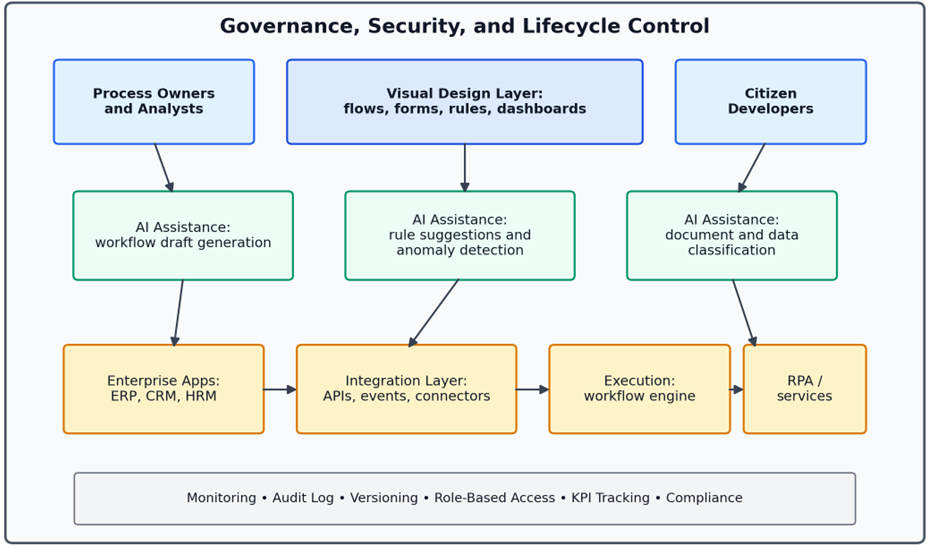
Fig. Layered architecture of intelligent no-code corporate automation
Figure presents INCPs as a layered orchestration environment rather than a standalone app builder. The upper layer contains the domain logic of business users, the middle layer translates this logic into visual flows, forms, decision rules, and AI-assisted recommendations, and the lower layer connects execution to enterprise systems, data services, and API- or robot-based actions. A cross-cutting governance layer spans the entire stack because access control, versioning, observability, and compliance logging are required throughout the automation lifecycle.
This configuration shows that the strategic value of INCPs depends largely on composability. In practice, enterprise processes rarely remain within a single application boundary: data are retrieved from multiple systems, enriched, routed through approval paths, and written back into operational platforms. Therefore, intelligent no-code automation should be assessed by interoperability and capacity for change absorption rather than by the visual simplicity of the editor. This interpretation aligns with recent studies emphasizing standardization, modularity, and integration fit as conditions for enterprise-scale LCNC adoption.
The growing role of AI in this architecture does not remove the need for disciplined model management. According to the 2025 Salesforce State of IT survey, 80% of developers reported that no-code and low-code tools help scale AI development, but the same survey highlighted the need for stronger oversight, documentation, and review of AI-generated artifacts [6]. Thus, the technological maturity of an INCP should be evaluated not only by the range of embedded AI functions, but also by their auditability, policy alignment, and consistency with enterprise process semantics.
Operational and economic effects in corporate infrastructure
When adoption moves from experimentation to enterprise deployment, the effectiveness of INCPs depends on the types of processes automated and the organizational architecture in which the platform is embedded. The strongest effects are usually observed in rule-intensive, document-heavy, and cross-departmental workflows. At the same time, performance, resilience, integration capacity, and cost structure must be assessed together, since local speed gains may be offset by weak governance or poor scalability [7].
Available quantitative evidence suggests that the operational benefits can be substantial when adoption is governed and linked to measurable use cases. According to the 2025 Mendix enterprise survey, 80% of organizations reported productivity gains, 79% reported reduced operational costs, and 73% reported improved time to market, while 98% indicated that low-code tools or features were already used somewhere in the development process. A Forrester study commissioned by Microsoft estimated a three-year ROI of 224% for a composite Power Platform deployment, with a net present value of USD 81.7 million and a payback period of less than six months [8, p. 63-68]. Although vendor-sponsored evidence should be interpreted cautiously, the convergence of productivity, cost, and backlog indicators suggests that the economic case for model-driven automation is increasingly robust.
The domain-specific profile of these effects is generalized in table.
Table
Functional profile of INCP adoption across selected corporate process domains
Process domain | Typical INCP functionality | Expected operational effect | Critical implementation condition |
Finance and accounting | Approval workflows, invoice validation, exception routing, close-task coordination | Reduced cycle time, stronger traceability, more consistent rule execution | Master-data quality; segregation of duties; auditability |
Human resources | Onboarding flows, request portals, document collection, policy acknowledgements | Lower administrative burden, faster handoffs, better policy compliance | Identity management; document security; role templates |
Customer service | Case intake, escalation routing, knowledge prompts, feedback loops | Faster response, standardized service logic, better service visibility | Channel integration; quality of customer data; SLA monitoring |
Procurement and logistics | Purchase requests, supplier coordination, status dashboards, exception handling | Improved cross-system coordination, fewer manual bottlenecks, clearer process ownership | API reliability; event synchronization; variant management |
Compliance and internal control | Evidence collection, review routing, reminder automation, control logs | Higher transparency, lower omission risk, better repeatability of controls | Retention rules; access controls; policy versioning |
Table shows that the value of INCP adoption varies across process domains. Finance and compliance benefit primarily from rule formalization, traceability, and cycle-time reduction; customer service and HR benefit from coordinated data capture and standardized interactions; procurement and logistics gain from event-driven integration across multiple systems. In all cases, however, the operational effect depends on whether process variability remains representable within declarative logic. When exception handling becomes dominant, the relative advantage of no-code abstractions decreases and the need for custom engineering grows.
The cloud dimension is also important. Research on service-sector cloud solutions shows that scalability, real-time support, data analysis, and application integration are central to process efficiency gains, especially when internal and customer-facing workflows must be synchronized [9, p. 95-109]. At the macro level, broader evidence on AI-enabled productivity further supports this view. An OECD discussion paper estimated that AI could add 0.2 to 1.3 percentage points to annual labour productivity growth across G7 economies over the next decade, depending on adoption intensity and complementary conditions [10]. This suggests that INCPs should be evaluated not merely as software tools, but as organizational infrastructure capable of converting general AI potential into repeatable process-level gains.
Governance, standardization and implementation constraints
The expansion of INCPs creates a tension between flexibility and standardization. While such platforms reduce dependence on scarce engineering resources and support local process redesign, uncontrolled growth of workflows and AI-enabled automations can fragment the application landscape. Enterprise value therefore arises only when local configurability remains aligned with shared architectural principles and governance mechanisms [11].
This challenge becomes more significant when AI is embedded in automation design. Gartner warns that weak governance may lead to uncontrolled AI-agent proliferation, insecure code, and compliance risks [12]. Survey data show that organizations recognize the value of low-code, no-code, and AI integration, but many still lack the infrastructure, resources, and training required for reliable deployment. This indicates that the effectiveness of INCPs depends not only on technical capabilities, but also on organizational maturity and formal control.
For this reason, sustainable implementation requires clear process selection, architectural boundaries, coordination mechanisms, policy-based governance, and metrics linking deployment to operational and business outcomes. Under these conditions, INCPs can function as controlled instruments of BPA rather than as isolated local experiments.
Conclusion
The analysis shows that INCPs have evolved beyond lightweight visual builders and now represent a distinct class of model-driven automation environments combining cloud integration, reusable process abstractions, embedded AI, and formal control mechanisms. Their practical value is highest in repetitive and medium-structured corporate processes where rapid redesign, cross-system orchestration, and execution transparency are required simultaneously. Thus, the study objective is confirmed: INCPs can serve as an effective tool for corporate BPA, but only under conditions of integration maturity, governance formalization, and sound economic assessment.
At the same time, enterprise adoption should not be interpreted as a replacement for professional software development. INCPs are better understood as a strategic automation layer that expands the joint capacity of business and IT units to formalize, deploy, and adjust workflows. Their long-term value will depend less on the novelty of visual tools than on the ability of organizations to embed them into a coherent enterprise operating model.
.png&w=640&q=75)