.png&w=384&q=75)
Primary school age is an important stage in the formation of a child's personality, when the foundations of learning activities, social interaction and self-esteem are laid. During this period, communication skills that allow children to successfully adapt to the team, as well as achievement motivation, which determines their desire for success in school, become especially important.
Studies show that children with developed communication skills demonstrate higher learning activity and stable motivation to achieve results [1]. However, the nature of the relationship between these two factors remains insufficiently studied [1].
The aim of the study is to identify the relationship between the level of development of communication skills and achievement motivation in younger schoolchildren.
Communication skills in primary school age include: the ability to listen and understand the interlocutor; the ability to clearly express their thoughts; skills of cooperation and conflict resolution; emotional responsiveness.
According to V. S. Mukhina, children aged 7-10 years actively develop the need for communication, which contributes to the formation of social intelligence and adaptation in the school environment [2].
Such scientists as O. A. Veselkova, A. E. Dmitriev, L. R. Munirova, A. A. Panfeeva, V. P. Ponutrieva, Yu. K. Babansky, V. V. Davydov, and P. Ya. Galperin studied communicative abilities [2].
According to Elkonin D. B. Elkonin, achievement motivation is a person's desire for success, overcoming difficulties and achieving high results. In primary school age, it manifests itself through: an interest in learning; a desire to receive positive grades; a desire for recognition from teachers and parents [3].
D. B. Elkonin's research shows that achievement motivation directly depends on the child's social environment, including his interaction with classmates and teachers [3].
The study involved 60 students in grades 2-3 (30 boys and 30 girls) aged 8-9 years.
The following methods were used to study the relationship between communication skills and achievement motivation: Test " Communicationskills "(L. Mikhelson, adaptation of A. V. Karpov); Achievement motivation questionnaire (A. Mehrabian, modification for children); Observation of children's behavior in educational and play activities.
As a result of studying the communicative abilities of children of primary school age using the "Communicative abilities" Test (L. Mikhelson, adaptation by A. V. Karpov), the following results were obtained. The data is shown in figure 1.
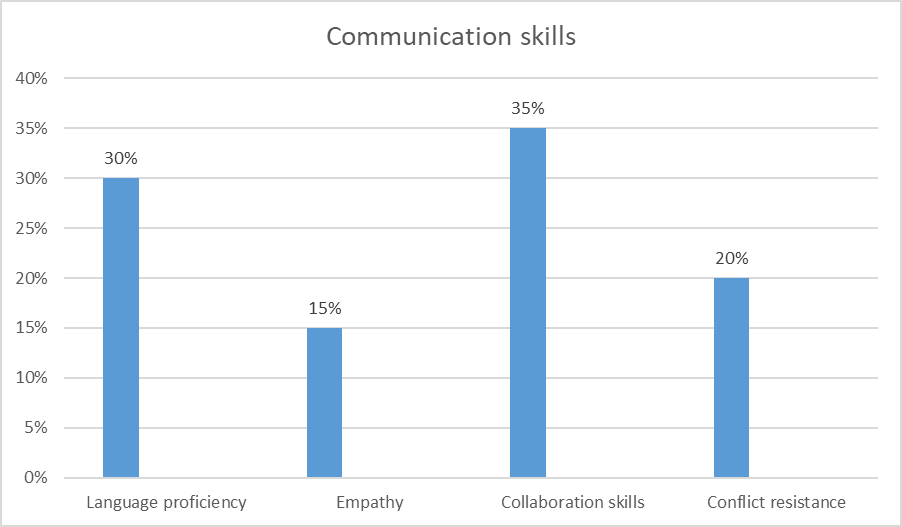
Fig. 1. Distribution of communication abilities of primary school students, %
Analyzing the data, we can see that 30% of primary school students have the ability to master speech, which is manifested in conversations and situations that require a response to positive words from a partner.
15% of primary school students have the ability of empathy, which is manifested in understanding the feelings of a partner.
35% of primary school students have the skills of cooperation when responding to requests from the interlocutor, and 20% of school students have the skill of conflict resistance in situations that make them react to a negative remark.
To study achievement motivation among children of primary school age, the achievement motivation questionnaire (A. Mehrabian, modification for children) was used. The results of the study are shown in figure 2.
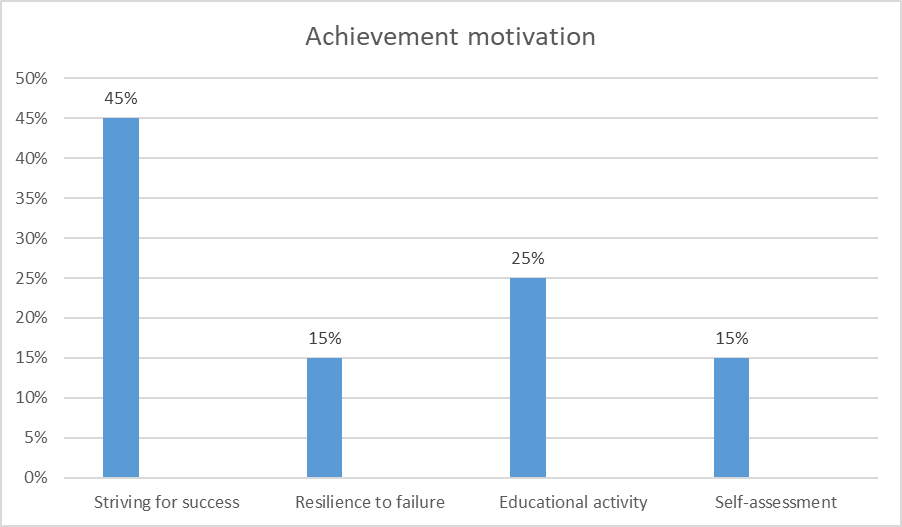
Fig. 2. Distribution of achievement motivation, %
To study the statistically significant relationship between the indicators, a correlation analysis using Spearman's r criterion was used Spearman. The results are presented in the table below.
Statistically significant correlation between indicators of communication abilities and achievement motivation of primary school-age children.
Table
Communication skills | Achievement motivation | Correlation coefficient (r) | Significance level |
Speech proficiency | Striving for success | 0.472** | p < 0.01,01 |
Empathy | Failure tolerance | 0.403** | p < 0.05,05 |
Collaboration skills | Learning activity | 0.521** | p < 0.01,01 |
Conflict tolerance | Self-esteem | 0.386** | p < 0.05,05 |
A moderate positive correlation was found between the development of communication skills and achievement motivation. Students with a high level of communication skills are more likely to show initiative in the classroom and less likely to avoid difficult tasks, demonstrating higher self-esteem (p< 0.05).
Thus, the data obtained confirm that developed communication skills contribute to the formation of a stable motivation for achievement. This is because children who are able to communicate effectively are more likely to find support from teachers and peers, which increases their self-confidence. Collaboration skills help you successfully complete group tasks, increasing your interest in learning. Emotional responsiveness reduces the level of anxiety, which is important for maintaining motivation.
.png&w=640&q=75)