.png&w=384&q=75)
Introduction
In the context of accelerating globalization and the deepening of regional economic cooperation, multilingual competence has become a strategic asset for nations seeking to broaden their diplomatic, economic, and cultural ties. Japanese, as one of the major languages of East Asia, occupies a distinctive position in the foreign language education systems of both China and Kazakhstan. In China, Japanese is the second most studied foreign language after English and enjoys a long institutional history supported by robust governmental policy. In Kazakhstan, by contrast, Japanese language education remains a relatively young and small-scale endeavor, yet one that is steadily gaining momentum as the country pursues diversified international partnerships under its multi-vector foreign policy.
Despite the growing importance of Japanese language education in both countries, systematic comparative studies examining how Chinese and Kazakh universities design their Japanese curricula and manage their teaching processes remain scarce. Most existing scholarship focuses on either the Chinese context or the Japanese language education landscape in Central Asia in isolation, without drawing cross-national comparisons that could illuminate best practices and areas for mutual learning. This gap is particularly noteworthy given that both countries share certain structural conditions: they are non-Anglophone nations with distinct dominant languages, both classify Japanese as a minor foreign language, and both have intensified their engagement with Japan through trade agreements, scholarship programs, and cultural exchange initiatives in recent years.
The present study aims to bridge this gap by conducting a comparative analysis of Japanese language curriculum construction and teaching management in representative Chinese and Kazakh universities. The paper addresses three research questions: (1) How do the two countries’ institutional frameworks for minor language education shape the structure and content of Japanese programs? (2) What similarities and differences exist in pedagogical approaches, resource allocation, and assessment practices? (3) What lessons can be drawn for improving the quality of Japanese language teaching in both national contexts? From the perspective of educational psychology, understanding how different institutional environments, curriculum designs, and management practices influence learner motivation, cognitive load, and learning outcomes is essential for developing evidence-based approaches to language education policy [11, p. 89].
Literature Review
The study of foreign language education policy and curriculum design has a rich international tradition. Scholars have long recognized that curriculum decisions are not merely technical but are shaped by political, economic, and sociocultural forces [1, p. 34]. Within this broader field, the teaching of less commonly taught languages – sometimes referred to as minor languages or critical languages – has received growing attention, particularly in the wake of geopolitical shifts that have created demand for linguistic expertise beyond English [7, p. 56].
In China, research on Japanese language education has expanded considerably since the early 2000s. Scholars have documented the rapid growth of Japanese departments across Chinese universities, noting that the number of institutions offering Japanese as a major exceeded 500 by the early 2020s [3, p. 46]. Studies have examined curriculum reform efforts, the integration of business Japanese and translation-oriented tracks, and the challenges of maintaining teaching quality amid enrollment expansion [9, p. 79]. The Chinese Ministry of Education’s national standards for foreign language majors, published in 2018, have provided a reference framework for Japanese curriculum design, specifying competency requirements across linguistic knowledge, intercultural communication, and critical thinking [4].
Research on Japanese language education in Kazakhstan and the broader Central Asian region is considerably less developed. Existing studies tend to be descriptive, focusing on the establishment of Japanese programs at institutions such as Al-Farabi Kazakh National University and the Kazakh Ablai Khan University of International Relations and World Languages [5, p. 115]. The Japan Foundation’s periodic surveys of overseas Japanese language education provide useful quantitative data on learner numbers, institutional settings, and teacher profiles, but offer limited insight into curricular design and management practices [2]. Some scholars have examined the role of Japan’s official development assistance in supporting Japanese language education in Central Asia [6, p. 702], while others have discussed the motivational profiles of Kazakh learners of Japanese [8, p. 515].
From an educational psychology standpoint, research on second and third language acquisition suggests that multilingual learners employ distinct cognitive strategies compared to monolingual learners of a foreign language [11, p. 89]. This finding is particularly relevant to the Kazakh context, where students typically acquire Japanese as a third or fourth language. Studies on learner motivation in minor language programs further indicate that instrumental and integrative motivational orientations may differ significantly across national and institutional contexts [12, p. 204], underscoring the need for comparative analysis. Comparative studies bridging the Chinese and Kazakh contexts remain extremely limited, and this paper draws on the conceptual framework of comparative curriculum studies [10, p. 205].
Methodology
This study employs a qualitative comparative research design. Data were collected through documentary analysis of official curriculum documents, syllabi, and institutional regulations from selected Chinese and Kazakh universities offering Japanese language programs. The Chinese sample includes program documents from three representative institutions: Beijing Foreign Studies University, Dalian University of Foreign Languages, and Shanghai International Studies University, selected for their recognized strength in Japanese language education. The Kazakh sample draws on materials from Al-Farabi Kazakh National University and Ablai Khan University of International Relations and World Languages, the two leading institutions for Japanese studies in Kazakhstan.
Supplementary data were obtained from publicly available reports by the Japan Foundation, the Chinese Ministry of Education, and the Kazakhstan Ministry of Science and Higher Education. The analysis follows a structured comparative framework organized around four dimensions: institutional framework and program structure, pedagogical approaches and teaching resources, teaching management and quality assurance, and internationalization and exchange mechanisms. Figure presents the overall research framework of this study.
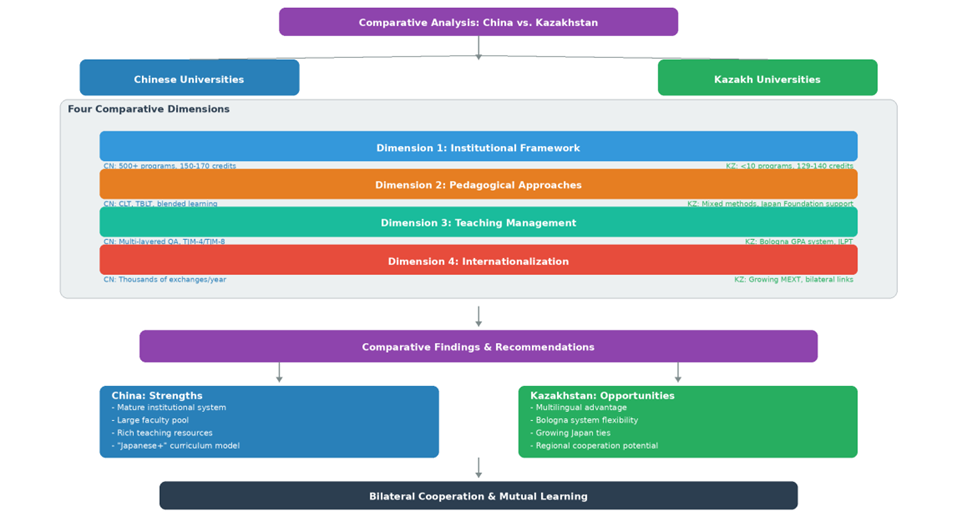
Fig. Comparative Research Framework for Japanese Language Programs
The limitations of this study should be acknowledged. The reliance on documentary sources means that the implemented and attained curriculum dimensions are addressed less thoroughly than the intended curriculum. Future research incorporating classroom observation, teacher interviews, and student surveys would provide a more comprehensive picture.
Institutional Framework and Program Structure
Chinese Universities
Japanese language education in China operates within a highly structured institutional framework governed by national educational policy. The Ministry of Education classifies foreign languages into commonly taught languages (primarily English) and uncommonly taught or minor languages, a category that includes Japanese, Korean, French, German, Russian, Spanish, Arabic, and others. Despite this classification, Japanese occupies a privileged position among the minor languages due to geographic proximity, historical ties, and the scale of Sino-Japanese economic relations.
Chinese universities offering Japanese programs typically do so within dedicated departments of Japanese language and literature or within broader schools of foreign languages. Programs are offered at both the undergraduate level (four-year bachelor’s degree) and the graduate level (master’s and doctoral degrees). The undergraduate curriculum follows a progressive structure: the first two years focus on foundational language skills including phonetics, grammar, reading, listening, and speaking, while the third and fourth years introduce specialized courses such as Japanese literature, linguistics, translation and interpretation, business Japanese, and Japanese culture [3, p. 48]. Most programs require students to pass the JLPT at N2 or N1 level before graduation. Credit allocation ranges from 150 to 170 total credits, with language skill courses accounting for approximately 60 to 70 percent [4]. A notable trend is the “Japanese plus” (Riyu+) curricula combining Japanese language training with expertise in fields such as international trade or information technology [9, p. 81].
Kazakh Universities
In Kazakhstan, Japanese language education is embedded within a different institutional architecture shaped by the Bologna Process reforms adopted in the late 2000s. The country’s higher education system uses a three-cycle degree structure (bachelor’s, master’s, doctoral), and curriculum design follows a credit-based system where one Kazakh credit equals approximately 30 hours of total student workload. Japanese is offered at a limited number of institutions, primarily within departments of Oriental or Asian studies, with fewer than ten institutions having dedicated programs [5, p. 116].
The undergraduate curriculum follows national state educational standards prescribing general education courses (history of Kazakhstan, philosophy, information technology), core professional courses, and elective courses. Japanese language skill courses occupy the professional core, while elective offerings may include Japanese history, culture, and economics. Due to smaller program sizes and limited faculty resources, the range of specialized courses is narrower than in Chinese institutions. A distinctive feature is the multilingual educational environment: students typically possess Kazakh and Russian proficiency before university, and many programs require English alongside Japanese, creating implications for cognitive load management and metalinguistic awareness [11, p. 92].
Table
Structural Comparison of Japanese Programs
Parameter | Chinese Universities | Kazakh Universities |
Institutions offering Japanese major | Over 500 | Fewer than 10 |
Degree levels | Bachelor’s, Master’s, Doctoral | Bachelor’s, Master’s |
Total undergraduate credits | 150–170 | 129–140 (Kazakh credits) |
Language skills share of curriculum | 60–70% | 45–55% |
Program affiliation | Dept. of Japanese Lang. & Lit. | Dept. of Oriental/Asian Studies |
External proficiency exam | JLPT N2/N1, TJM-4/TJM-8 | JLPT (recommended) |
Students’ prior languages | Mandarin Chinese, English | Kazakh, Russian, English |
Specialized course offerings | Extensive | Limited |
Pedagogical Approaches and Teaching Resources
Teaching Methods
Chinese universities have developed a relatively mature pedagogical tradition in Japanese language teaching. The dominant approach has historically been grammar-translation, reflecting both the influence of Chinese pedagogical traditions and the structural similarities between Chinese and Japanese writing systems, particularly the shared use of kanji. However, the past two decades have seen a gradual shift toward communicative language teaching, task-based language teaching, and blended learning approaches [3, p. 50]. Many institutions now incorporate multimedia materials, online learning platforms, and native-speaker conversation classes. The educational psychology literature suggests that such diversified approaches better accommodate individual differences in learning styles and cognitive processing preferences [12, p. 210].
In Kazakhstan, pedagogical approaches vary more widely across institutions. Some instructors trained in Japan employ communicative and proficiency-oriented approaches, while others from the post-Soviet linguistic tradition rely more heavily on structural and grammar-based methods. The Japan Foundation’s teacher training programs and textbook provision, notably the Marugoto and Minna no Nihongo series, have been influential in shaping pedagogical practice [2].
Teaching Staff and Materials
A significant difference lies in the scale and qualifications of the teaching force. Chinese universities collectively employ thousands of Japanese language teachers, many with doctoral degrees from Chinese or Japanese universities, supported by a national academic community with professional associations, journals, and conferences [9, p. 82]. Kazakh universities face more acute challenges in teacher recruitment, with the total number of qualified instructors limited and some programs depending heavily on visiting Japanese instructors from the Japan Foundation or JICA programs [5, p. 118].
Chinese publishers produce a wide array of domestically tailored Japanese language textbooks aligned with national teaching standards, supplemented by online platforms and corpus-based learning tools. In Kazakhstan, reliance on imported textbooks from Japan and Russia is more pronounced, and the development of locally produced resources accounting for Kazakh learners’ specific linguistic backgrounds remains limited [12, p. 215].
Teaching Management and Quality Assurance
In Chinese universities, teaching management for Japanese programs is handled through a multi-layered system involving the university’s academic affairs office, the college of foreign languages, and the departmental teaching committee. Regular teaching evaluations, classroom inspections, peer observation, and student feedback surveys are standard practices. Many institutions also participate in external quality assessments conducted by the Ministry of Education [4]. Assessment combines mid-term and final examinations, oral proficiency tests, and standardized external instruments including the JLPT and the national TJM-4 and TJM-8 examinations [3, p. 51].
Kazakh universities have adopted quality assurance mechanisms reflecting both Soviet-era traditions and Bologna Process standards. Internal QA involves departmental self-assessments, teaching portfolio reviews, and student evaluations. External accreditation is conducted by independent agencies. For small programs such as Japanese, the QA process may be less robust than for larger departments [5, p. 119]. Assessment follows the GPA system with continuous assessment and final examinations. The JLPT serves as the primary external benchmark, though testing site availability within the country is limited. The Chinese system emphasizes standardized, norm-referenced evaluation, while the Kazakh system places greater weight on criterion-referenced continuous assessment [11, p. 95].
Both countries have developed exchange programs with Japanese universities, though at different scales. Chinese universities send thousands of students to Japan annually through government-funded scholarships, institutional agreements, and self-funded programs [10, p. 208]. Kazakh universities participate through MEXT scholarships and Japan Foundation fellowships on a smaller scale. Al-Farabi Kazakh National University and several other institutions have established direct partnerships with Japanese universities, but geographic distance and higher travel costs present additional challenges [6, p. 710].
Comparative Discussion
The comparison reveals several key patterns meriting discussion from both pedagogical and educational psychology perspectives. First, scale and institutional maturity represent the most fundamental difference. China’s Japanese language education ecosystem is vastly larger and more developed, benefiting from decades of investment, a large population base, and deep economic ties with Japan. Kazakhstan’s programs, while growing, remain small-scale and more dependent on external support. This disparity has cascading effects on curriculum breadth, faculty specialization, and peer learning communities.
Second, curriculum structure reflects broader systemic differences. Chinese programs follow a specialized model in which students major exclusively in Japanese from year one, allowing intensive and sustained skill development. Kazakh programs, shaped by the Bologna system’s emphasis on breadth, require a substantial proportion of general education courses, potentially reducing language learning hours. The educational psychology literature on deliberate practice and time-on-task suggests that the Chinese model’s greater concentration of hours may produce more rapid proficiency gains, though the Kazakh model’s broader curriculum may foster more transferable cognitive skills [11, p. 97].
Third, the multilingual context of Kazakh higher education creates both opportunities and challenges. Students who are already bilingual in Kazakh and Russian may possess enhanced metalinguistic awareness facilitating additional language learning [8, p. 520]. However, the cognitive demands of managing four or more languages may create competition for learning time and attention. Fourth, both countries face shared challenges in adapting to digital transformation of language education, incorporating intercultural competence and critical thinking, and preparing students for diverse career paths beyond translation and teaching.
Conclusion
This comparative analysis has demonstrated that Chinese and Kazakh universities approach Japanese language curriculum construction and teaching management from different institutional starting points and with different resource endowments, yet face a number of convergent challenges in an era of rapid educational change. China’s mature and large-scale system offers valuable models in curriculum design, quality assurance, and teacher development, while Kazakhstan’s flexible and multilingual educational environment provides a distinctive context for innovation in minor language pedagogy. The educational psychology perspective adopted in this study highlights the importance of attending to learner characteristics, motivational dynamics, and cognitive processes when designing and evaluating language education programs.
By learning from each other’s experiences and establishing closer bilateral cooperation, universities in both countries can enhance the quality and relevance of their Japanese language programs, ultimately contributing to the broader goal of fostering multilingual talent for an interconnected world. Future research should extend this comparative framework through empirical data collection, including classroom observation, learner interviews, and longitudinal tracking of student outcomes, to deepen understanding of how institutional structures translate into lived educational experiences.
.png&w=640&q=75)