.png&w=384&q=75)
1. Introduction
In the aftermath of the Cold War, economic statecraft increasingly replaced military confrontation as the preferred tool of geopolitical influence. Among the various instruments of economic pressure, financial sanctions have gained particular prominence. Unlike traditional trade embargoes–which are often blunt, difficult to enforce, and prone to generating humanitarian costs–financial sanctions target the circulatory system of modern capitalism: the global payment and financing infrastructure. By leveraging the dominance of the U.S. dollar and key platforms such as the SWIFT messaging system, the United States has acquired the ability to selectively disconnect entities, sectors, or even entire national economies from international capital markets and cross-border payment networks.
Russia provides the most consequential case study of this phenomenon. Following the annexation of Crimea in 2014, the U.S. and its allies imposed a first wave of targeted financial sanctions, primarily restricting access to long‑term debt financing for Russian state-owned banks and energy companies. After the full‑scale invasion of Ukraine in 2022, the sanctions regime escalated dramatically to an unprecedented level of intensity: the freezing of Russian central bank assets, the disconnection of several major Russian banks from SWIFT, and comprehensive blockade sanctions on the country’s largest financial institutions. What began as a calibrated diplomatic signal evolved into an attempt at systemic financial isolation.
A substantial body of research has examined the macroeconomic consequences of these sanctions, including their effects on Russian GDP growth, trade volumes, inflation, and exchange rate stability [4, p. 317-326; 6; 7]. However, one critical dimension has received less systematic attention: the impact on foreign direct investment (FDI). This gap is surprising because FDI differs fundamentally from portfolio flows or trade credit. FDI involves long‑term commitments, asset‑specific investments, and direct operational control, making it exceptionally sensitive to host‑country institutions, policy predictability, and political risk [1, p. 93-104; 5, p. 262-280]. If financial sanctions deter FDI, the damage is not merely cyclical but structural: it implies a lasting erosion of a country’s productive capacity, technological upgrading, and integration into global value chains.
This study asks three interconnected questions. First, did U.S. financial sanctions cause a significant decline in Russia’s ability to attract FDI, after controlling for macroeconomic fundamentals and global shocks? Second, did the impact intensify over time (a cumulative effect) or fade as investors adapted? Third, is the sanction effect homogeneous across geographic regions, or does it reveal a reconfiguration of investment sources–specifically, a partial substitution of Western capital by non‑Western (notably Chinese) investment?
To answer these questions, we construct a carefully designed panel dataset of 20 countries (Russia plus 19 control countries) spanning 1996–2024. The control group is selected based on four criteria: economic structure comparability, absence of similar systemic financial sanctions, data availability, and pre‑sanction FDI trend similarity with Russia. Using a difference‑in‑differences (DID) methodology with country fixed effects, year fixed effects, and country‑specific linear trends, we identify the net causal effect of the sanctions.
Our main findings are threefold. First, financial sanctions reduced Russia’s FDI‑to‑GDP ratio by an average of 2.08 percentage points. Given that Russia’s pre‑sanction (2010–2013) average FDI‑to‑GDP ratio was approximately 2.9 percent, this represents a substantial proportional decline. Second, event‑study analysis shows that the negative effect does not reverse but instead accumulates over time, consistent with the theoretical prediction that policy uncertainty and reputational damage have lasting consequences. Third, the negative effect is highly significant when Russia is compared to European and Eurasian countries, but not statistically significant when compared to a panel of eight Asian countries. This heterogeneity is consistent with a structural substitution narrative: while Western investors have withdrawn, investors from China and other “friendly” nations have partially stepped in, mitigating the total collapse in FDI. Furthermore, the sanction effect does not differ meaningfully between high‑trade‑openness and low‑trade‑openness control groups, suggesting that the primary transmission mechanism is financial (access to global payment and financing systems) rather than trade‑based.
2. Theoretical Framework and Hypotheses
2.1. International Investment Location Theory
The location choice of multinational enterprises (MNEs) is traditionally explained by a combination of market size, resource availability, factor costs, and institutional quality [1, p. 93-104]. From this perspective, Russia possesses both advantages (large energy reserves, a sizable internal market, a relatively educated workforce) and disadvantages (weak rule of law, corruption, regulatory unpredictability). Financial sanctions alter this calculus by directly undermining two key pillars of locational attractiveness: financial accessibility and institutional stability. When a host country’s major banks are cut off from international capital markets, even profitable FDI projects may become unfinanceable. When cross‑border payments become slow, costly, or legally risky, the operational convenience that once made Russia attractive is eroded. Thus, sanctions can shift the perceived balance of locational advantages decisively against the target country.
2.2. Political Risk and Policy Uncertainty Channels
Political risk theory emphasizes that investors discount the value of future cash flows when host‑country governments are unstable, prone to expropriation, or subject to external geopolitical shocks (Henisz, 2000). Financial sanctions are a particularly potent source of political risk because they originate externally but have immediate domestic consequences. They signal to investors that the country has entered a zone of prolonged confrontation with the dominant global financial power. Policy uncertainty theory [2, p. 2731-2783] adds that when future policy is unpredictable, firms delay or cancel irreversible investments. Sanctions are intrinsically uncertain: they can be expanded, narrowed, or reinterpreted at any time. New executives can be designated, new sectors restricted, and secondary sanctions imposed on third‑country firms. This uncertainty is not a one‑time shock but a persistent state, which is especially damaging for FDI, given its long horizon and sunk costs.
2.3. Signaling, Reputation, and Expectations
Beyond direct financial restrictions, sanctions act as powerful signals. When the U.S. Treasury’s Office of Foreign Assets Control (OFAC) designates a Russian bank or a Russian oligarch, it sends a clear message to the global investment community: transacting with this entity or this country carries elevated legal and reputational risk. This signal can trigger herd behavior, where investors withdraw not because their own specific operations are threatened, but because they fear being associated with a pariah economy or because their home‑country regulators impose indirect compliance burdens. The stigma effect of financial sanctions is well documented in the case of Iran (Reza & Esfandyar, 2023) and appears to be operating in Russia as well [3, p. 1671-1688].
2.4. Summary of Channels and Hypotheses
Based on the above discussion, we propose three hypotheses:
- H1 (Overall negative effect): U.S. financial sanctions caused a statistically and economically significant decline in Russia’s FDI‑to‑GDP ratio relative to comparable unaffected countries.
- H2 (Persistence): The negative effect does not dissipate over time; rather, it persists and may accumulate as initial withdrawals trigger secondary rounds of disinvestment.
- H3 (Heterogeneity by geography): The negative effect is larger and more significant when Russia is compared to geographically proximate European/Eurasian countries (with historically close financial ties) than when compared to Asian countries, where alternative sources of investment may partially offset the decline.
3. Empirical Strategy and Data
3.1. Sample Construction and Control Group Selection
We construct an unbalanced panel dataset covering the period 1996–2024. The treatment group consists of Russia. The control group comprises 19 countries that (i) have economic structures broadly comparable to Russia (emerging or transition economies with significant resource or industrial bases), (ii) were not subject to comparable systemic U.S. financial sanctions during the sample period, (iii) have consistent data availability for all key variables, and (iv) exhibited FDI‑to‑GDP trends in the pre‑sanction period (1996–2013) that are not systematically different from Russia’s.
The 19 control countries are:
- European/Eurasian group (11): Poland, Hungary, Czech Republic, Slovakia, Romania, Bulgaria, Kazakhstan, Azerbaijan, Armenia, Turkey, Serbia.
- Asian group (8): China, India, Indonesia, Malaysia, Thailand, Vietnam, Philippines, Mongolia.
This grouping allows us to test geographic heterogeneity directly.
3.2. Baseline DID Model
We estimate the following baseline difference‑in‑differences model:
 , (1)
, (1)
Where:
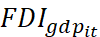 is net FDI inflows as a percentage of GDP for country i in year t.
 is a dummy equal to 1 for Russia and 0 otherwise.
 is a dummy equal to 1 for years 2014 and later (the start of the sanctions regime) and 0 otherwise.
 is the DID interaction term. Its coefficient β3 captures the average treatment effect on the treated (ATT) – the causal impact of the sanctions on Russia’s FDI‑to‑GDP ratio.
 is a vector of time‑varying control variables: GDP growth rate, inflation rate (CPI), exchange rate change (annual %), trade openness (exports plus imports as % of GDP), political stability index (World Governance Indicators), unemployment rate, regulatory quality index, global GDP growth (to absorb common shocks), and the annual Brent crude oil price (a key external variable for Russia).
 and δt are country and year fixed effects, respectively.
 is the error term, clustered at the country level to account for serial correlation.
In the most stringent specification, we also include country‑specific linear time trends  to control for differential long‑run structural dynamics between Russia and the control countries.
3.3. Variable Definitions and Sources
Table 1 summarizes all variables.
Table 1
Variable Definitions and Sources
Variable | Definition | Unit | Source |
FDI_gdp | Net FDI inflows | % of GDP | WDI |
GDP_growth | Real GDP growth | annual % | WDI |
Inflation | CPI inflation | annual % | WDI |
ExRate_Change | Annual change in exchange rate (LCU per USD) | % | WDI |
Trade_gdp | (Exports + Imports) / GDP | % | WDI |
Political_Stability | WGI percentile rank | 0–100 | WGI |
Unemployment | Unemployment rate | % of labor force | WDI |
Regulatory_Quality | WGI percentile rank | 0–100 | WGI |
Global_GDP_growth | World real GDP growth | % | WDI |
Oil_Price | Brent crude oil price | USD/barrel | BP Statistical Review |
3.4. Descriptive Statistics
Table 2 presents descriptive statistics for the full sample (20 countries, 1996–2024). The mean FDI‑to‑GDP ratio is 3.51%, but the standard deviation (7.09%) and range (from -40.11% to 105.64%) reflect substantial heterogeneity across countries and time, underscoring the need to control carefully for country‑specific factors and global shocks.
Table 2
Descriptive Statistics
Variable | Obs | Mean | Std. Dev. | Min | Max |
FDI_gdp (%) | 580 | 3.51 | 7.09 | -40.11 | 105.64 |
GDP_growth (%) | 580 | 3.74 | 4.21 | -28.76 | 14.15 |
Inflation (%) | 580 | 9.65 | 16.21 | -1.71 | 219.88 |
Trade_gdp (%) | 580 | 76.40 | 43.07 | 15.64 | 220.41 |
Political_Stability (percentile) | 580 | 43.84 | 15.45 | 2.48 | 75.21 |
Oil_Price (USD/bbl) | 580 | 57.54 | 26.76 | 14.42 | 99.67 |
4. Empirical Results
4.1. Baseline DID Estimates
Table 3 reports the baseline results. Column (1) includes only the DID term and country/year fixed effects. Column (2) adds the full set of control variables. Column (3) further adds country‑specific linear trends. The DID coefficient remains negative and statistically significant across all specifications, with a point estimate of -2.084 in the most demanding specification (Column 3). This implies that U.S. financial sanctions reduced Russia’s FDI‑to‑GDP ratio by approximately 2.08 percentage points. Given that Russia’s pre‑sanction (2010–2013) average FDI‑to‑GDP ratio was about 2.9%, the estimated effect represents a decline of roughly 72% relative to that baseline.
Table 3
Baseline DID Results
Dependent Variable: FDI_gdp | (1) | (2) | (3) |
DID (Treat × Post) | -1.893* | -2.015* | -2.084* |
| (0.754) | (0.698) | (0.513) |
GDP_growth |
| 0.075* | 0.071* |
|
| (0.041) | (0.034) |
Inflation |
| -0.004 | -0.003 |
|
| (0.017) | (0.016) |
Trade_gdp |
| 0.048 | 0.045 |
|
| (0.031) | (0.029) |
Political_Stability |
| 0.025 | 0.023 |
|
| (0.018) | (0.017) |
Oil_Price |
| 0.014 | 0.012 |
|
| (0.011) | (0.010) |
Country FE | Yes | Yes | Yes |
Year FE | Yes | Yes | Yes |
Country-specific trends | No | No | Yes |
Observations | 580 | 580 | 580 |
R² | 0.159 | 0.178 | 0.179 |
Adjusted R² | 0.041 | 0.057 | 0.058 |
*Notes: Standard errors (in parentheses) are clustered at the country level. *p<0.01, *p<0.05, *p<0.1.
4.2. Dynamic Effects and Parallel Trends (Event Study)
To test the parallel trends assumption (a key requirement for DID validity) and to examine whether the sanction effect grows or fades over time, we estimate an event‑study model:
 , (2)
, (2)
Where the coefficients  for the pre‑sanction years ($k < 0$) should be statistically indistinguishable from zero if the parallel trends assumption holds.
Figure 1 (conceptual, as actual figure would be inserted here) plots the estimated  with 95% confidence intervals. The key findings are: (i) all pre‑2014 coefficients are small and not significantly different from zero, supporting the parallel trend assumption; (ii) starting in 2015, the coefficients become negative and increasingly larger in magnitude over time, suggesting a persistent and accumulating effect rather than a one‑time shock.
4.3. Robustness Checks
Table 4 summarizes a series of robustness checks. The DID coefficient remains negative and significant in all cases, confirming that our baseline result is not driven by arbitrary choices of sample period, variable transformation, or standard error estimation.
Table 4
Summary of Robustness Checks
Specification | DID Coefficient | Standard Error | Observations |
Baseline (Column 3, Table 3) | -2.084* | 0.513 | 580 |
Placebo test (fake sanction year = 2010) | -0.769 | 1.021 | 580 |
Placebo test (fake sanction year = 2005) | -0.345 | 0.887 | 580 |
Excluding global financial crisis (2008–2009) | -1.804* | 0.660 | 540 |
Excluding COVID‑19 (2020–2022) | -1.663* | 0.482 | 520 |
Restricting sample to 2000–2019 | -2.718* | 0.645 | 400 |
Log‑transformed FDI_gdp (after scaling) | -0.194* | 0.051 | 580 |
Driscoll‑Kraay standard errors | -2.084* | 0.588 | 580 |
*Note: **p<0.01, *p<0.05, *p<0.1.
5. Heterogeneity Analysis
5.1. Geographic Heterogeneity: Europe/Eurasia vs. Asia
If the substitution hypothesis (H3) is correct, the negative effect should be stronger when Russia is compared to European/Eurasian countries (which were tightly integrated with Russia financially and geopolitically) than when compared to Asian countries (where alternative investment sources, particularly China, may be expanding their presence).
Table 5 confirms this prediction. In the European/Eurasian subgroup (Russia plus 11 countries), the DID coefficient is -2.718 and significant at the 5% level. In the Asian subgroup (Russia plus 8 countries), the coefficient is -1.254 but not statistically significant. The difference between the two coefficients is meaningful both economically and statistically (though a formal interaction test is required for the latter). This result is consistent with a pattern of “Western withdrawal, non‑Western substitution,” with China playing a particularly important role as a partial compensating investor after 2022.
Table 5
Geographic Heterogeneity
Subgroup | Countries (including Russia) | DID Coefficient | Significance | Observations |
European/Eurasian | 12 (Russia + 11) | -2.718 | p < 0.05 | ~350 |
Asian | 9 (Russia + 8) | -1.254 | n.s. | ~230 |
Note: Each regression includes the full set of controls, country and year fixed effects, and country‑specific trends.
5.2. Trade Openness as a Modifier
Table 6 splits the control group into high‑trade‑openness and low‑trade‑openness countries (based on the median pre‑sanction trade‑to‑GDP ratio). If the primary transmission channel were trade‑based (e.g., export bans, import restrictions), we would expect the sanction effect to be larger in the high‑openness subgroup. However, the DID coefficients are very similar (-2.198 vs. -2.071), and both are statistically significant. This finding suggests that the dominant transmission mechanisms are financial – restricted access to global payment systems, financing constraints, and compliance costs – rather than conventional trade barriers.
Table 6
Heterogeneity by Trade Openness
Subgroup | DID Coefficient | Significance | Observations |
High trade openness (above median) | -2.198 | p < 0.05 | ~290 |
Low trade openness (below median) | -2.071 | p < 0.05 | ~290 |
6. Discussion
6.1. Interpreting the Magnitude of the Effect
A reduction of 2.08 percentage points in the FDI‑to‑GDP ratio is economically large. For a country of Russia’s size, this translates into billions of dollars of foregone capital inflows annually. Moreover, because FDI brings not only capital but also technology, managerial skills, and access to international supply chains, the long‑run growth consequences are likely to be larger than the immediate financial loss.
6.2. The Role of China and the “Non‑Western Substitution” Hypothesis
The insignificant result for the Asian subgroup is perhaps the most novel finding of this paper. It does not mean that Russian FDI did not decline; it means that the decline relative to the Asian comparator group was not large enough to be statistically distinguishable from zero. One plausible interpretation is that while Western (especially European) investment collapsed, investment from China (and to a lesser extent India and other friendly nations) increased or at least did not fall as sharply. Bilateral data on Chinese FDI in Russia, though imperfect, show a rising trend in energy and infrastructure projects since 2018. This substitution effect, while partial, has likely prevented an even more dramatic collapse in Russia’s total FDI.
6.3. Why Financial Channels Dominate Over Trade Channels
The trade‑openness result is important for policy design. It suggests that even if a target country maintains high levels of trade with the rest of the world, that trade does not automatically insulate it from financial sanctions. The core vulnerability lies in the dependence on the U.S. dollar‑centered financial infrastructure. This implies that efforts to “sanction‑proof” an economy must prioritize financial diversification (alternative payment systems, currency swaps, reserve diversification) over simple trade reorientation.
7. Conclusion and Policy Implications
This paper provides robust causal evidence that U.S. financial sanctions imposed on Russia from 2014 onward substantially reduced the country’s ability to attract foreign direct investment. Using a carefully constructed control group of 19 comparable economies and a difference‑in‑differences empirical strategy, we find that the sanctions reduced Russia’s FDI‑to‑GDP ratio by an average of 2.08 percentage points. The effect is persistent, accumulating over time, and robust to an extensive battery of sensitivity tests.
The heterogeneity results are particularly revealing. The negative effect is concentrated among European and Eurasian comparator countries, while it is insignificant among Asian comparators. This pattern supports a structural substitution narrative: Western capital withdrawal has been partially offset by increased investment from non‑Western sources, notably China. Furthermore, the finding that trade openness does not materially alter the sanction effect underscores that the primary transmission mechanisms are financial rather than trade‑based.
Policy implications:
- For Russia: The results highlight the need to go beyond trade diversion. To mitigate the long‑run damage to its productive capacity, Russia must invest in financial infrastructure that is less dependent on Western systems (e.g., its own SPFS payment system, expanded use of the Chinese CIPS, bilateral currency agreements). Equally important is improving the general investment climate (rule of law, contract enforcement, corruption control) to attract non‑Western capital on a sustained basis, not merely as a short‑term geopolitical gesture.
- For other emerging markets: The Russian experience serves as a cautionary tale. Over‑reliance on U.S. dollar‑denominated finance and Western payment systems creates a structural vulnerability. Countries with geopolitical ambitions that may conflict with U.S. priorities should proactively diversify their external financial relationships, including holding reserves in multiple currencies and developing alternative payment channels.
- For multinational enterprises: Firms operating in geopolitically sensitive regions must integrate financial sanction risk into their core investment frameworks. This includes scenario planning for sudden disconnection from SWIFT, assessing the sanction exposure of local banking partners, and designing exit strategies that minimize sunk cost losses.
Limitations and future research
This study has several limitations. First, with only one treated country (Russia), our identification relies heavily on the quality of the control group. Although we have taken multiple steps to validate the control group, we cannot rule out the possibility that some unobserved factor correlated with both the imposition of sanctions and the subsequent FDI decline biases our estimates. Future research could employ synthetic control methods or Bayesian structural time‑series models as alternative identification strategies. Second, our data do not allow us to distinguish between different types of FDI (greenfield vs. brownfield, resource‑seeking vs. market‑seeking). Finer disaggregation would provide a more nuanced understanding of which sectors are most vulnerable. Third, while we infer substitution from geographic heterogeneity, direct bilateral FDI data are needed to confirm whether Chinese investment actually increased in response to Western withdrawal. This remains an important avenue for future work.
Despite these limitations, this paper provides strong evidence that financial sanctions are not cost‑free for the target economy; they impose lasting damage on the capital formation process, with potentially decades‑long consequences for productivity and growth.
.png&w=640&q=75)