.png&w=384&q=75)
Introduction
Financial digital platforms increasingly operate as distributed software systems where payments, onboarding, scoring, reporting and customer communication depend on application programming interfaces (APIs), service-level agreements and cloud infrastructure. The relevance of architectural optimization is strengthened by higher transaction loads, open banking growth and stricter operational resilience requirements. The United Kingdom open banking ecosystem recorded 24.0 billion successful API calls in 2025, which shows the scale of external integration pressure on financial platforms [1]. In parallel, the Digital Operational Resilience Act (DORA) has applied since 17 January 2025 and requires financial entities to manage information and communication technology (ICT) risks in a documented and testable manner [2]. The purpose of this article is to evaluate architectural optimization of financial digital platforms as a technical and economic mechanism for improving operational efficiency. The research problem is the need to combine high availability, low latency, security controls and cost discipline within one architecture rather than treating them as separate engineering tasks.
Drivers of architectural optimization in financial platforms
The optimization agenda is formed by several concurrent drivers: growth of API consumption, regulatory pressure, cloud cost volatility and higher expectations for digital service continuity. API-oriented platforms are especially sensitive to unstable gateways, weak versioning and insufficient monitoring, since these defects affect partner integrations and customer-facing processes [3, p. 13-24]. The main conditions influencing architectural decisions are presented in table.
Table
Key conditions shaping architecture of financial digital platforms [1; 2; 4; 5, p. 2620-2631]
Condition | Architectural implication |
Regulatory resilience | Architecture must support recovery testing, logs and auditable control procedures |
API traffic growth | API gateways, rate limits, caching and service-level monitoring become core design elements |
Global API expansion | Scalable integration layers and versioned contracts are required |
Cloud cost pressure | Cost allocation must be assessed by product domain and transaction profile |
The table shows that platform architecture is shaped by both market growth and formal control requirements. Availability alone is insufficient if the platform cannot provide traceability, incident evidence and predictable recovery. For this reason, optimization should be assessed through combined indicators. A platform may process more requests, yet remain inefficient if scaling leads to uncontrolled cloud expenditure, excessive service coupling or higher support costs.
Technical mechanisms of optimization
The technical basis of optimization is service decomposition with clear boundaries. Microservice architectures for financial platforms reduce dependence between product domains, yet excessive fragmentation increases network calls and diagnostic complexity [6, p. 49-55]. The most stable approach is to split services around business capabilities and preserve strict interface contracts. Containerization and orchestration support this model through standardized deployment, isolated runtime environments and automated scaling. Kubernetes-based practices improve adaptability, though they require policy control, secret management and continuous monitoring to avoid configuration drift [7, p. 2038-2045]. Latency management is a separate layer of optimization. For transaction-heavy platforms, delays increase retry traffic and infrastructure load, while network tuning in Linux systems, queue configuration and connection pooling can reduce avoidable waiting time [8, p. 43-51]. The optimization logic is shown in figure.
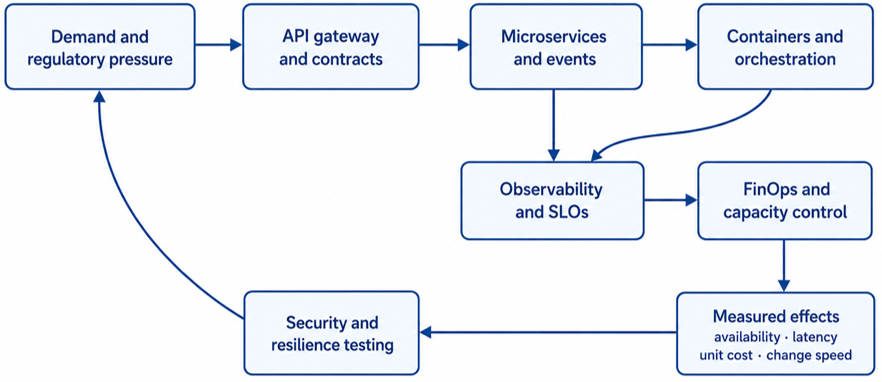
Fig. Logic of architectural optimization of a financial digital platform
The scheme links engineering interventions with operational and economic effects. API contracts, orchestration, observability and latency control should be managed as one optimization cycle, since each layer influences availability and operating cost. Security must be integrated into the same cycle. The 2025 API survey indicates strong concern about unauthorized or excessive API calls and API-related data exposure, which makes access control, rate limiting and anomaly detection necessary parts of architectural efficiency rather than additional functions [9].
Economic assessment and managerial implications
The economic effect of optimization is expressed through lower incident losses, better cost predictability and shorter change cycles. Architectural optimization of distributed systems is associated with reduced operating costs when redundancy, load balancing and observability are aligned with demand patterns rather than applied as isolated technical upgrades [10, p. 63-67]. Financial Operations (FinOps) provides a practical evaluation frame because it connects infrastructure consumption with financial accountability. In this logic, the relevant indicators include cost per transaction, idle capacity, autoscaling efficiency, deployment rollback frequency and downtime-related losses. Customer-facing channels also influence architectural requirements. Digital interaction environments support long-term customer relationships in the B2C segment, which means that outages, slow responses and unstable notification services can affect loyalty and retention, not only technical service quality [11, p. 99-96]. The managerial assessment should be performed at product-domain level. A payment service, a loan origination service and a customer notification service may require different latency thresholds, resilience targets and cost limits. A uniform infrastructure policy is easier to administer, yet it can hide inefficient allocation of computing resources.
Conclusion
Architectural optimization of financial digital platforms is a mechanism for balancing availability, regulatory resilience, latency and economic efficiency. The analysis shows that API-oriented design, controlled microservice decomposition, orchestration and observability create value when they are connected with measurable business outcomes. A platform can be considered operationally efficient when it processes growing traffic without proportional growth of incidents, support costs and cloud expenditure. The practical result is not only faster software delivery, but also more stable financial services, clearer accountability for ICT risks and better control over the cost of digital growth.
.png&w=640&q=75)