.png&w=384&q=75)
1. Introduction
Against the wave of digital transformation, artificial intelligence has become an essential tool to improve the quality of corporate strategic decision-making. Different from traditional decision-making dominated by managers’ experience, AI relies on data computing and scenario simulation to reduce information asymmetry and decision bias. Nevertheless, practical observation reveals that many enterprises invest heavily in AI systems but fail to obtain expected strategic benefits, which highlights the necessity to explore the drivers and barriers of AI application performance.
The TOE framework provides a mature multi-dimensional analytical paradigm covering technological, organizational and environmental conditions. Existing relevant literature mainly focuses on enterprises’ AI adoption intention, while fewer studies target practical performance of AI used for high-level strategic decisions. Meanwhile, the internal transmission mechanism connecting TOE factors and application results still needs further clarification.
Therefore, this paper establishes a research model containing mediating variables (Figure 1) and addresses two core questions: (1) Which TOE factors significantly affect AI application performance in corporate strategic decision-making? (2) What mediating role does organizational innovation culture play in the above relationships?
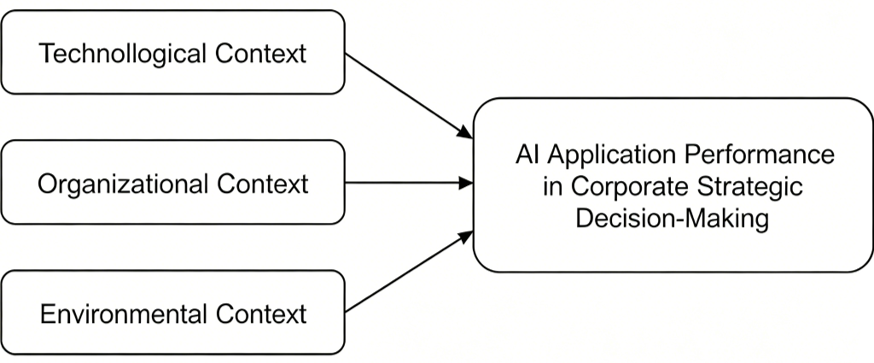
Fig. Theoretical Research Model
Note: Solid arrows = positive impact; dashed arrow = negative impact; all independent variables have direct effects on dependent variable and indirect effects via organizational innovation culture.
2. Theoretical Background and Research Hypotheses
2.1 TOE Framework
Proposed by Tornatzky et al. (1990), the TOE framework divides influencing factors of technological innovation into three categories. The technological context refers to characteristics of available technologies; the organizational context involves internal resources, management structure and corporate culture; the environmental context includes industrial competition, policy regulation and market environment. This framework has been widely applied to research on enterprise digital technology adoption.
2.2 Variable Definition and Hypothesis Development
Technological context: Relative advantage, system compatibility, perceived risk. Higher relative advantage and better system compatibility encourage enterprises to apply AI in strategy formulation; perceived risk including data security risks and uncertain investment returns hinders AI value realization.
Organizational context: Top management support, organizational resource readiness. Leaders’ strategic recognition and sufficient talents & funds create basic conditions for intelligent decision-making. Organizational innovation culture is defined as the mediator, representing an atmosphere that accepts technological trials and tolerates innovation failures.
Environmental context: Industrial competitive pressure, government policy support. Peer digital competition pushes firms to deploy AI; supportive policies reduce the cost of intelligent transformation.
Dependent variable: AI application performance in strategic decision-making, reflected by improved decision efficiency, accuracy and long-term competitive advantages.
Based on theoretical deduction, the hypotheses are proposed: H1–H8: TOE related factors significantly affect AI application performance. H9: Organizational innovation culture mediates the relationships between TOE factors and AI application performance.
3. Research Methodology
3.1 Data Collection
Questionnaire survey is adopted. Respondents are middle and senior managers participating in corporate strategic work. After screening invalid samples, 326 valid questionnaires are finally obtained, with an effective response rate of 84.68%.
Table 1
Sample Profile (N=326)
| Classification | Category | Proportion (%) |
| Enterprise Scale | Large enterprise | 31.28 |
| Medium enterprise | 45.40 | |
| Small enterprise | 23.32 | |
| AI usage time for strategy | Less than 1 year | 25.15 |
| 1–3 years | 48.77 | |
| More than 3 years | 26.08 |
3.2 Measurement and Estimation Approach
All items adopt 5-point Likert scale (1 = strongly disagree, 5 = strongly agree). Measurement scales are adapted from existing mature studies. This paper uses PLS-SEM (SmartPLS 4.0) to test the theoretical model.
4. Empirical Results
4.1 Direct Effect Test
Table 2
Path Coefficients and Hypothesis Results
| Hypothesis | Path | Standardized β | p-value | Outcome |
| H1 | Relative Advantage → Performance | 0.213 | <0.001 | Supported |
| H2 | System Compatibility → Performance | 0.186 | <0.01 | Supported |
| H3 | Perceived Risk → Performance | -0.152 | <0.05 | Supported |
| H4 | Top Management Support → Performance | 0.247 | <0.001 | Supported |
| H5 | Resource Readiness → Performance | 0.201 | <0.001 | Supported |
| H7 | Competitive Pressure → Performance | 0.168 | <0.01 | Supported |
| H8 | Policy Support → Performance | 0.194 | <0.001 | Supported |
4.2 Mediating Effect
Bootstrap method (5000 subsamples) verifies the mediating effect. Organizational innovation culture generates significant indirect effects for all paths. Perceived risk presents full mediation, and other variables present partial mediation. Therefore, H9 is supported.
4.3 Result Summary
Top management support shows the largest positive coefficient, which means organizational willingness from senior executives is the core prerequisite for successful AI application in strategic affairs. Perceived risk significantly suppresses performance, indicating security concerns and return uncertainty are important obstacles.
5. Discussion and Conclusion
5.1 Theoretical Contributions
First, this study expands the application scenario of the TOE framework and shifts research focus from “adoption intention” to “practical strategic performance”. Second, this paper identifies organizational innovation culture as an important transmission channel, clarifying the internal mechanism of how multi-level factors influence AI outcomes. Third, the research confirms the negative role of perceived risk, supplementing empirical evidence in AI strategic management literature.
5.2 Practical Implications
Enterprises should improve the matching degree between AI systems and internal management processes, avoid blind investment and strengthen data risk control. Senior managers need to attach importance to intelligent decision-making, allocate sufficient funds and professional talents, and build an innovation-tolerant corporate culture. In addition, firms should actively respond to industrial competition and make full use of government digital support policies.
5.3 Limitations and Future Research
This research relies on cross-sectional data and cannot capture dynamic changes over time. Subsequent research can adopt longitudinal surveys. Further studies can introduce moderating variables such as organizational agility or conduct multi-group comparison among different industries.
5.4 Main Conclusion
Technological, organizational and environmental factors jointly determine AI application performance in corporate strategic decision-making. Organizational innovation culture plays a vital mediating role between TOE antecedents and strategic application performance.
.png&w=640&q=75)