
Introduction
The digital transformation of education has turned the classroom into a smart educational environment in which learning platforms, sensors and intelligent tutoring systems continuously record how students learn [7; 12]. Most applications of these data, however, focus on academic performance: predicting grades, recommending content or identifying students at risk of dropping out [1, p. 267-270; 2, p. 61-75; 8, p. 170-179]. The psychological side of learning – emotions, motivation, cognitive load and stress – is monitored far less systematically, even though it strongly shapes engagement and achievement [6, p. 59-109; 9, p. 315-341]. In practice, teachers and counsellors usually notice psychological difficulties only after they have already affected learning outcomes or well-being.
This paper addresses the question of how monitoring in a smart educational environment can be turned into timely psychological and educational support for learners. Its aim is to present a conceptual framework that integrates artificial-intelligence (AI) based recognition of learners' psychological states with a tiered early warning mechanism and a system of pedagogical and psychological interventions.
Theoretical background
Three lines of research inform the framework. First, studies of smart education describe the smart learning environment as context-aware, adaptive and data-rich, capable of providing personalised support in real time [7, 12]. Second, educational psychology explains why psychological states matter for learning: the control-value theory links achievement emotions to students' appraisals of control and value [9, p. 315-341], self-determination theory relates motivation to the satisfaction of autonomy, competence and relatedness needs [10, p. 68-78], and engagement research treats behavioural, emotional and cognitive engagement as interrelated components [6, p. 59-109]. Third, affective computing and learning analytics have shown that emotions such as confusion, frustration and boredom can be detected from facial expressions, speech, physiological signals and interaction logs [3, p. 18-37; 4, p. 145-157; 5].
What is still missing is a coherent link between recognition and support. Detection models are often evaluated only by their accuracy, while the question of what teachers, counsellors and the system itself should do after a risk is detected remains open. Psychological and educational support is understood here as a coordinated system of pedagogical and psychological measures that helps learners maintain emotional balance, motivation and productive engagement; monitoring is valuable only to the extent that it triggers such support.
Proposed framework
The proposed framework consists of four interconnected layers (fig. 1). The data perception layer collects multimodal information from learning platforms, classroom video and audio, wearable devices, periodic self-report questionnaires and academic records. The psychological state recognition layer fuses these features and uses machine-learning models to estimate the learner's current emotional, cognitive and motivational state. The early warning layer converts the estimates into an individual risk index and compares it with dynamic, learner-specific thresholds, so that a gradual negative trend is detected as well as a sudden change. Finally, the support layer selects and delivers interventions according to the warning level.
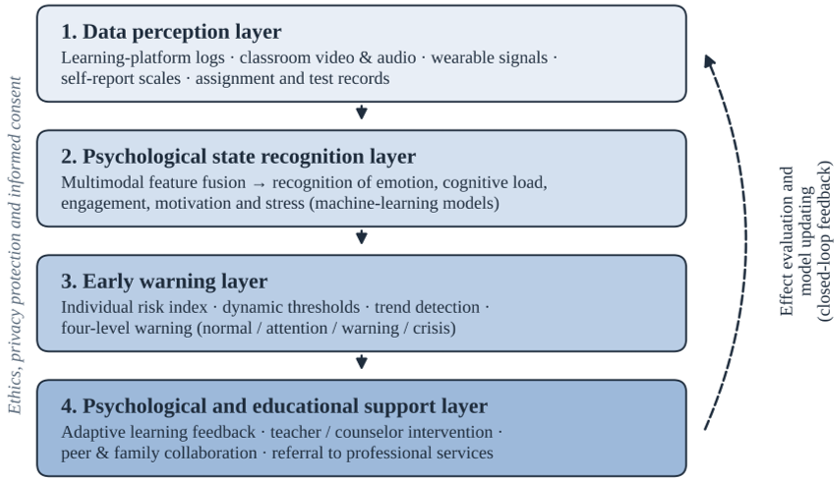
Fig. 1. Four-layer framework of psychological state recognition, early warning and support in a smart educational environment
The psychological dimensions monitored by the framework and their typical data sources are summarised in table 1. Combining objective behavioural and physiological indicators with learners' own self-reports reduces the bias of any single channel and keeps the learner's perspective in the assessment [5; 6, p. 59-109].
Table 1
Monitored psychological dimensions and data sources
Dimension | Typical indicators | Main data sources |
Emotional state | Confusion, frustration, boredom, anxiety, enjoyment | Facial expression, speech, self-report |
Engagement | Time on task, participation, attention, persistence | Platform logs, classroom video |
Cognitive load | Error patterns, response latency, help-seeking | Interaction logs, test records |
Motivation | Goal setting, voluntary activity, task choice | Logs, questionnaires |
Stress and well-being | Physiological arousal, sleep and activity changes | Wearables, screening scales |
Early warning levels and support strategies
To make warnings actionable, the framework uses four levels, each linked to an explicit responsible party and support measure (tab. 2). Lower levels are handled automatically or by the teacher within the learning process, while higher levels involve counsellors, families and, when necessary, professional mental-health services. Automated outputs are never treated as a diagnosis: every warning above the attention level is reviewed by a qualified person before any intervention.
Table 2
Early warning levels and corresponding support
Level | Typical signal | Support measure (responsible party) |
I – Normal | Stable, positive state | Routine adaptive feedback and encouragement (system) |
II – Attention | Short-term negative emotion or reduced engagement | Adjusted task difficulty, hints, teacher check-in (system, teacher) |
III – Warning | Persistent negative trend over several sessions | Individual conversation, learning plan revision, peer support (teacher, counsellor) |
IV – Crisis | Severe or rapidly worsening psychological indicators | Immediate counselling, family contact, referral to professional services (counsellor, specialists) |
The layers operate as a continuous cycle (fig. 2): monitoring feeds recognition and risk assessment, the warning activates targeted support, and the effect of support is evaluated and returned to the system to update thresholds and models. The learner remains at the centre of this cycle, and the goal is psychological well-being together with learning success rather than control over behaviour.
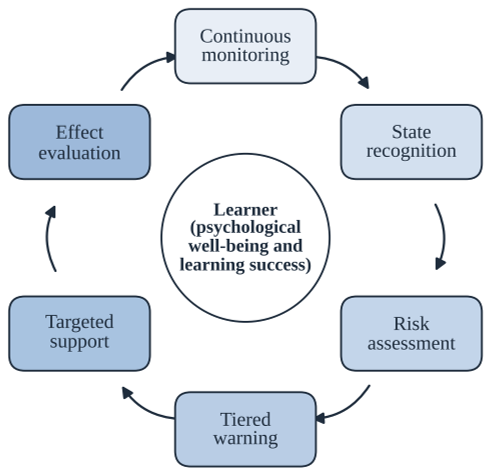
Fig. 2. Closed-loop cycle of monitoring and psychological and educational support
Ethical considerations
Psychological monitoring involves sensitive personal data, so the framework embeds ethical safeguards in every layer: informed consent and the right to opt out, data minimisation and anonymisation, transparency about what is monitored and why, and human oversight of all decisions that affect a learner [11, p. 1510-1529]. Monitoring results should serve support only and must not be used for grading, ranking or disciplinary purposes.
Conclusion
The paper has proposed a framework that connects AI-driven psychological state recognition with tiered early warning and targeted psychological and educational support in a smart educational environment. Its contribution lies in treating monitoring and support as a single closed loop with clearly defined indicators, warning levels, responsible parties and ethical safeguards. Further research within the author's dissertation will validate the recognition and warning components on publicly available learning-emotion and student mental-health datasets and examine the effectiveness of the proposed support strategies.