Introduction
Global gaming market trends in 2022 point to a transition to a new phase of industry development, characterized by structural shifts in both audience size and the functional role of digital gaming environments. Analysts estimate that nearly 3.2 billion people will play games in 2022, further cementing the perception of gaming as a leading form of social interaction [1]. Mobile communications are the primary driver of global market growth, generating $103.5 billion in revenue this year [1]. The Russian market is demonstrating accelerated growth: at the beginning of 2022, there were 129.8 million internet users in Russia. From 2021 to 2022, the number of users increased by 5.8 million. Moreover, the internet penetration rate in Russia was 89 % of the total population at the beginning of 2022 [2]. Under these conditions, the Malinovka project – an online game focused on authentic modeling of Russian realities in a Role Play format – operates in a highly saturated supply environment, where the strategic objective becomes the maximization of user lifetime value (LTV).
The issue of audience retention functions as a system-forming factor for the long-term sustainability of any online service. Empirical evidence suggests that a 5% reduction in churn rate may correlate with a 25–95% increase in overall profitability; as a result, forecasting player behavior acquires the status of a managerial priority [3]. At the same time, despite the substantial body of research concentrated on “classical” MMORPGs, the scholarly field continues to exhibit a pronounced shortage of studies addressing the specificity of RP projects, where game logic is inseparable from social dramaturgy, role-based practices, and the simulation of real social mobility mechanisms. This deficit is expressed in the absence of adapted life-cycle models capable of adequately describing the transition from resource-accumulation mechanics to the management of social capital and positioning within closed virtual communities [4, 5].
The purpose of the study is to reveal multilevel behavioral indicators that precede the termination of a player’s activity, as well as to design a system of design interventions oriented toward stabilizing and strengthening the user base of the Malinovka project.
The novelty of the approach lies in substantiating a non-linear dependence of retention factors on the stage of a participant’s social development: at later stages, the determining significance is attributed to the “social viscosity” of factions as a predictor of loyalty, exceeding traditional measures of in-game achievement in explanatory power.
Within the proposed hypothesis, it is assumed that introducing mechanisms that simultaneously reduce behavioral entropy and increase the value of in-game reputational status can substantially decrease churn risk in the most engaged segments of the audience.
Materials and Methods
The methodological design of the study was formed through a combination of quantitative data-analytic procedures and qualitative interpretation of game systems, enabling a holistic view of retention and engagement both as measurable behavioral phenomena and as outcomes of digital environment design. The applied research logic incorporated several complementary approaches.
A systematic review of scholarly sources was conducted using publications indexed in Scopus, IEEE, ACM, and Springer; this coverage enabled the conceptualization of key theoretical foundations of engagement, including self-determination theory and flow theory [5]. In parallel, predictive models used for churn forecasting were compared, with particular attention to the machine-learning algorithms Random Forest, Logistic Regression, and LSTM, tested on data from projects such as Blade & Soul and World of Warcraft. This made it possible to assess differences in explanatory and predictive effectiveness across comparable classes of game ecosystems [3]. To incorporate domain specificity, a case study of the Malinovka project was carried out, examining architectural elements of its game systems – factional organization, economic cycles, and role-interaction mechanics. This supported the transfer of general theoretical propositions into the context of a specific platform while preserving their analytical validity. An additional layer of empirical interpretation was formed through content analysis of technical documentation, focusing on update patterns, balance adjustments, and loyalty systems applied in the industry as instruments for retention management [8, 9].
The source base was structured into three typological groups. The first group consisted of academic journal articles and conference proceedings devoted to game analytics and the psychology of gaming behavior, prioritizing scientifically verifiable results and reproducible methods. The second group comprised analytical reports produced by leading consulting organizations – McKinsey, Deloitte, and Newzoo – describing market trends for 2022 and outlining forecast contours of industry development through 2025 [13]. The theoretical segment of the study further relied on works analyzing drivers of player longevity and the stability of user trajectories, developed on the basis of large-scale industrial cases [16].
Results and Discussion
An analysis of gameplay telemetry and users’ behavioral trajectories in MMORPGs makes it possible to identify a set of “early signals” of churn that emerge prior to the complete cessation of activity. Empirical results indicate that the key diagnostic value is not, or at least not primarily, the reduction of total time spent in the game, but rather the disruption of a stable participation regularity expressed through an increase in behavioral entropy [15, 18]. When a player shifts from a predictable login rhythm to a fragmented, irregular pattern, a sharp increase in exit probability is observed: for users whose attendance schedule becomes chaotic, the churn risk within the next 3–7 days is higher by 95% [18].
Within the context of the Malinovka project, relevant predictors can reasonably be grouped into four dimensions: progress indicators, in-game purchasing parameters, characteristics of social interaction, and stable behavioral patterns. The combined influence of these factors is non-uniform and depends on segment membership; this is reflected in the changing weights of individual predictors when comparing user groups, as shown in Table 1.
Table 1
Significance of behavioral predictors for different player segments (compiled by the author based on [3])
| Factor group | Metrics | Newcomers (0–14 days) | Active (15–60 days) | Veterans (60+ days) |
| Progression | Experience gain rate, job unlocks | Critical (85%) | Medium (40%) | Low (15%) |
| Economy | Transaction frequency, currency balance | Low (10%) | High (65%) | Medium (45%) |
| Socialization | Number of friends, chat messages, faction ties | Medium (30%) | High (75%) | Critical (90%) |
| Regularity | Session entropy, time between logins | High (70%) | High (80%) | High (85%) |
The analytical interpretation of the obtained data shows that, for Malinovka veterans, the decisive retention mechanism is the density and perceived significance of social ties formed within the in-game community. This dependence aligns with motivational frameworks suggesting that, at advanced stages of gaming identity development, the resource-accumulation logic becomes less dominant, while the need for “relatedness” – a stable sense of belonging to a meaningful group and of recognition within a social structure – takes precedence [6, 10].
The player life cycle in the RP ecosystem of Malinovka is characterized by nonlinearity and trajectory variability, since advancement is determined not only by mechanical progression but also by shifts in status, role, and position within the network hierarchy. The present analytical framework employs a four-act model that captures the sequential evolution of user experience across four phases, each associated with a distinct churn-risk profile. An illustrative representation of user survivability dynamics across different time horizons is provided in Figure 1.
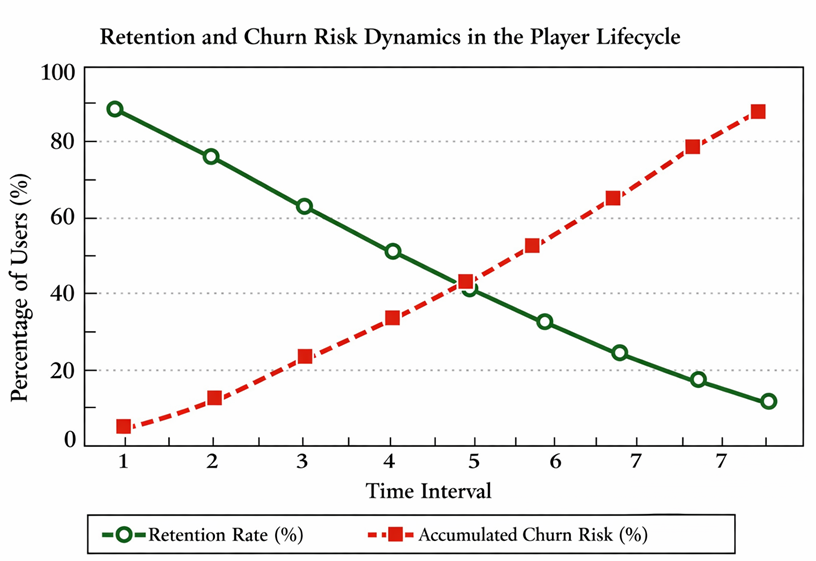
Fig. 1. Player survivability curve and cumulative churn risk (compiled by the author based on [5, 7])
The critical period of initial entry into Malinovka is concentrated within days 1–7 and is defined by vulnerability to an early break in the user trajectory. During this window, the leading causes of disengagement are cognitive overload driven by the complexity of interlinked systems, along with a lack of rapid social integration; as a result, a sense of belonging to stable micro-groups fails to form. The most effective measures for stabilizing behavior are scenario-driven onboarding quests and the provision of “starter packages” of resources that reduce frustration stemming from early economic constraints while simultaneously accelerating the transition toward meaningful participation in core mechanics [24, 25].
The 7–30 day interval corresponds to the progression phase, in which a pragmatic orientation toward material status markers dominates – most notably, the acquisition of property and vehicles. Churn risk in this period is shaped primarily around a “grind barrier”: the cost of the next meaningful asset begins to require disproportionately large time investments, while qualitatively new forms of gameplay experience are not activated. As a consequence, the perception of monotony intensifies, and the subjective value of continued participation declines even as the structure of gameplay remains essentially unchanged.
The 30–60 day window is characterized by deepening social embeddedness and the institutionalization of role-based ties through entry into factions (e.g., Ministry of Internal Affairs, Army, organized criminal groups). At this point, retention is determined less by individual progression metrics and more by parameters of group dynamics. The quality of internal leadership, the distribution of roles, the presence of clear interaction norms, and the regularity of participation in collective events become critical, functioning as mechanisms that consolidate identity and build reputational capital.
After 60 days, a stage of mastery and managerial agency becomes visible, in which the player either occupies leadership positions or consolidates an “opinion leader” status. At this stage, baseline content loses novelty, while participation becomes more demanding in emotional and organizational terms. Accordingly, the primary threat is emotional burnout, amplified by the absence of clearly articulated long-horizon goals and by a deficit of meaning-making reference points commensurate with the achieved level of social responsibility.
The author’s life-cycle model scheme, adapted for the Malinovka project, is presented in Figure 2.
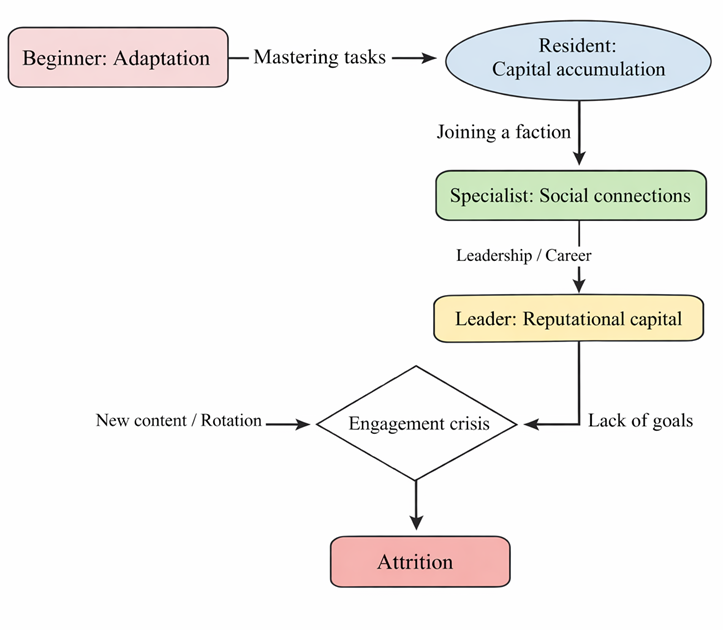
Fig. 2. Author’s Player Lifecycle Model for an RP server
To increase retention, the implementation of interventions is required that act on the player’s psychological triggers. Table 2 presents the key strategies, differentiated by levels of impact.
Table 2
Matrix of design interventions and their effects on retention metrics (compiled by the author based on [9, 11, 20, 21, 22, 26])
| Intervention type | Specific mechanic | Target segment | Expected retention change (Day 30) |
| Behavioral | Daily rewards with a cumulative effect | All players | +5–8% |
| Social | Cooperative faction quests and “family” wars | Active players | +12–15% |
| Content-driven | Seasonal updates (Battle Pass) | Veterans | +10% |
| Economic | Dynamic taxes and purchase cashback | Paying users | +7% |
Particular attention should be given to the “reputation system.” In RP projects, reputation functions as a form of “second currency.” A player who has invested hundreds of hours in building a career in the police or mafia is psychologically less inclined to leave due to the high level of unrecoverable costs (sunk costs) and the prospective loss of social status [14, 23].
Figure 3 illustrates the structure of interrelations between game mechanics and the player’s psychological attachment.
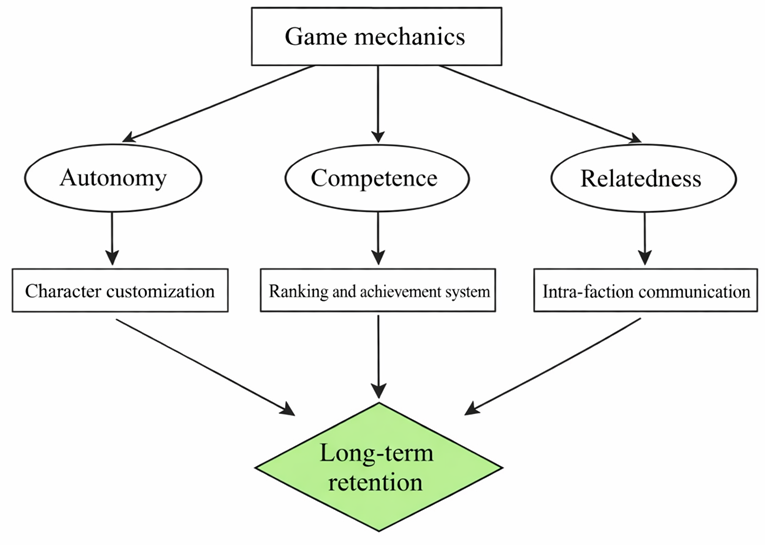
Fig. 3. Hierarchical model of psychological determinants of retention (compiled by the author based on [6])
Sustained audience retention in an RP environment is inseparable from a functionally “healthy” in-game economy, since it is the economic contours that define goal horizons, the pace of progression, and the subjective attainability of status positions. Within the Malinovka project, the economic architecture should maintain a delicate balance between stimulating early development for newcomers and restraining inflationary processes capable of devaluing effort and undermining perceived reward fairness. Errors in the parameterization of prices for premium objects – including luxury-class vehicles and elite real estate – create the risk of a structural “break” in motivation among mid-segment players: when the attainability threshold of goals steadily shifts into a zone perceived as inaccessible, the sense of continuing accumulation strategies weakens, which is reflected in an accelerated growth of churn [22].
The key risks and retention barriers relevant to the economy and associated behavioral trajectories are systematized and presented in Table 3.
Table 3
Analysis of engagement risks and barriers (compiled by the author based on [9, 12, 22, 27, 28])
| Risk | Mechanism of influence | Consequences | Mitigation approach |
| Toxicity | Negative player behavior in voice chat | Newcomer churn within the first 24 hours | Implement reputation and moderation systems |
| Technical default | Lag, server errors, loss of property | Immediate loss of loyalty | Optimize networking code and improve QoE [28] |
| Inflation | Devaluation of earned in-game money | Reduced value of achievements | Introduce currency sinks (taxes, repairs) |
| Burnout | Monotony of role-based scenarios | Departure of faction leaders | Event rotation and global story arcs |
An integral analysis of the overall results makes it possible to register the high retention potential of the Malinovkaproject, driven primarily by a pronounced cultural identity and an effect of recognizability in the social scenarios reproduced in the RP format. At the same time, realizing this potential requires a revision of product-management priorities: a simple expansion of the content volume tends to be of limited effectiveness without a targeted impact on the structure and dynamics of social graphs that determine the durability of role ties and the distribution of statuses [17, 19]. A key direction is the reduction of excessive behavioral variability, since increasing unpredictability of user trajectories correlates with the weakening of habitual participation rhythms, the blurring of group engagement, and a higher probability of exit.
Conclusion
The conducted analysis has shown that retention and engagement in the Malinovka project are formed as an effect of a multi-component interaction between behavioral determinants and the architecture of social systems that set the boundaries of role participation and reputational exchange. A conceptually significant result is the substantiation of the need for stage-differentiated management of the user base: the effectiveness of interventions is determined by the alignment of tools with a specific life-cycle phase and with the dominant motives of activity at that stage.
The practical value of the work is defined by the possibility of directly integrating predictive models into the product-analytics loop used by Malinovka’s management and development team. The deployment of an early-warning churn system based on monitoring behavioral variability is considered a means of reducing losses of the active audience by 15–20%. The author’s hypothesis regarding the increasing role of social centrality at later stages received empirical support in the analysis of veteran longevity factors, indicating the priority of managing network positions and group ties over traditional achievement-based metrics. Prospects for further research are associated with a deeper examination of how “virtual fashion” and customization practices influence emotional attachment to the character as one of the mechanisms of retention.