
Relevance of the study
The relevance of the study is due to the rapid increase in the number of autism spectrum disorders and the peculiarities of cognitive impairments characteristic of this group of diseases. The main obstacle to the successful socialization and adaptation of children with autism is a significant impairment in the ability to social perception, including serious difficulties in recognizing, understanding and adequately expressing their own and others' emotions.
Traditional verbal methods of psychological and pedagogical correction often turn out to be ineffective due to specific problems with processing speech information, difficulties with perceiving abstract concepts, and deficits in the "Theory of Mind" that are characteristic of autism.
Clinical observations and research in neurobiology confirm that in most people with ASD, the visual channel of information perception is the most preserved and functionally developed. Therefore, the development and scientific substantiation of methods for structured visual support in developing the emotional sphere are becoming key tasks of modern special psychology. Solving this problem directly helps reduce anxiety, prevent affective outbursts, and generally improve the quality of life for children with autism.
The purpose of the study
The aim of the study is to provide a theoretical justification, practical development and empirical assessment of the effectiveness of a structured visual approach for developing skills in recognizing, understanding and regulating emotions in children with autism. In addition, we strive to create an integrated and adaptive visual support model that can be effectively used both in a specialized educational environment and in everyday life at home.
Materials and research methods
The research materials and methods are based on a comprehensive longitudinal design, which includes the ascertainment, formation, and control stages of the experiment. Standardized diagnostic tools are used in order to comply with the principles of evidence-based practice. The assessment of the basic level of social and emotional dysfunction is conducted using the CARS Child Autism Rating Scale and the PEP-3 Psychoeducational Testing Profile.
The formative phase of the experiment involved introducing a comprehensive corrective program centered on a structured visual approach. Within this framework, we used a set of visual and didactic materials called "Emotions for Growth," developed by the author, aimed at step-by-step skill development in recognizing, differentiating, and verbalizing emotions among children with ASD. This set includes visual scales, flashcards, story tasks, and social modeling elements, ensuring a gradual transition from static images to understanding emotions in context.
The results of the study
The history of studying the ability of children with autism to understand emotions has come a long way, from the first clinical descriptions to modern complex neurocognitive models.
This process was initiated in the 1940s by psychiatrists Leo Kanner and Hans Asperger. In his writings, Kanner first identified two main signs of autism: extreme loneliness and an innate inability to establish affective contact. At this stage, emotional detachment was considered the main factor of social isolation, and the mechanisms of understanding emotions were not yet the subject of separate study.
In the 1980s, important changes took place in the field of social perception research. During this period, Peter Hobson hypothesized a primary affective deficit. His research empirically proved that children with autism have difficulty recognizing facial expressions, postures, and sounds. At the same time, Simon Baron-Cohen, Uta Frith, and Alan Leslie proposed the concept of a "Theory of Mind," which revolutionized the understanding of this disorder. They proved that problems with interpreting other people's emotions arise from a basic cognitive deficit – the inability to understand the mental states, intentions, and feelings of both oneself and others.
In the 1990s and 2000s, research interest shifted towards neuroscience and the use of precise hardware diagnostic methods. Ami Klin's pioneering work on eye-tracking technology clearly demonstrated atypical patterns of visual attention in individuals with ASD when processing social stimuli. He found that children with autism focus mainly on mouth areas or geometric contours when scanning faces, ignoring eye areas, which carry important information about emotional states. This led to the development of theories about amygdala dysfunction and mirror neuron system deficits, which explain the neurophysiological basis of empathy and facial recognition difficulties.
At the present stage, since the 2010s, the learning paradigm has undergone significant changes. The hypothesis of alexithymia, proposed by Jeff Bird and Richard Cook, has gained considerable influence. According to their research, acute difficulties in identifying and describing emotions are not related to autism itself, but rather to comorbid alexithymia, which is more common among people with ASD than among the general population [6, p. 9-18].
It is worth noting that the modern concept of emotional intelligence development in children with autism is based on the use of alternative ways of thinking, neuroplasticity, and modern technologies. Today, experts do not just show emotion cards to children but create interactive, realistic, and predictable environments for them (fig.). The main goal is to translate the intuitive understanding of affective signals, which is characteristic of neurotypical people, into a logical and structured system. This process is based on the strengths of children with autism: their detailed visual perception and a pronounced tendency to systematize information.
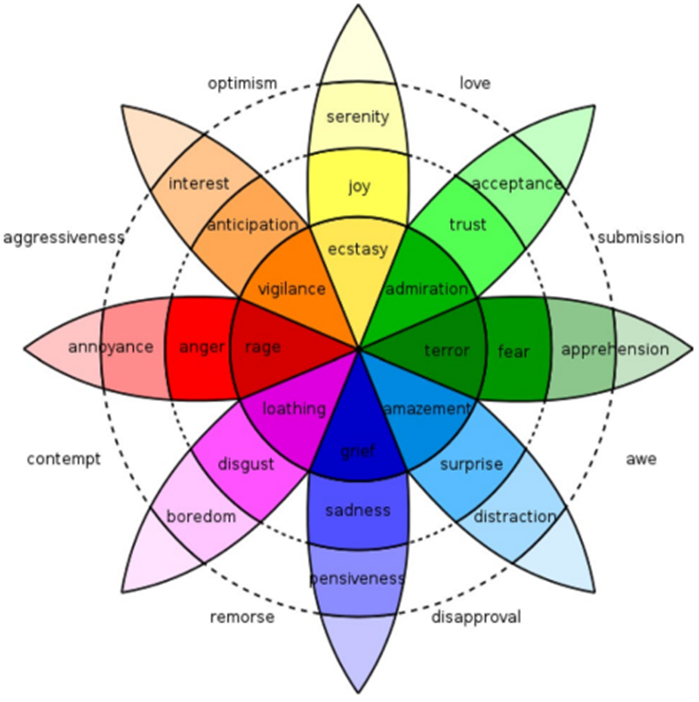
Fig. The wheel of emotions [2, p. 809-825]
One of the most innovative approaches in modern therapy is the use of social robots and specialized digital applications. Robot assistants like KASPAR or Milo are designed with simplified, slow motion, and easily predictable facial expressions. This allows children to explore basic emotional states in a safe environment, completely avoiding the sensory overload that is often caused by a living human face with its complex and unpredictable microexpressions.
At the same time, gamified interactive applications are actively used. These programs, designed for tablets and smartphones, are equipped with built-in cameras and facial recognition algorithms. They encourage eye contact by rewarding the child in a playful way for keeping their attention on the other person's eyes and correctly recognizing their social smiles and furrowed eyebrows.
In modern clinical practice, virtual reality technology is widely used to safely train social perception skills. Special VR simulations immerse the child in realistic everyday situations where he interacts with digital avatars. The software allows the specialist to slow down and repeat the reactions of avatars many times, as well as visually highlight certain patterns of facial expressions and changes in posture. This allows a child with autism spectrum disorders to step-by-step train the skill of recognizing emotions in conditions as close as possible to real life, but at the same time completely controlled. This approach significantly reduces the level of social anxiety, which is crucial for improving the quality of life [1, p. 3567-3574].
In the field of cognitive behavioral therapy, programs that link visual recognition of other people's emotions with self-regulation and logical analysis have become the modern standard. An example of this is the Zone of Regulation concept, which categorizes complex emotional states using strict color-coding. Children learn to relate facial expressions and behaviors to a specific area, making the world of human emotions more structured and understandable [3].
In addition, modern approaches, such as the inclusive JASPER methodology, are aimed at developing joint attention in the process of free play. In such circumstances, understanding the emotions of others, whether peers or a therapist is formed not because of mechanical memorization, but as a vital skill for successfully continuing the game and achieving common goals (tab.).
Table
JASPER Inclusive methodology
No. | Elements of the methodology | Characteristic |
1 | Joint Attention | Exercises that promote interaction between a child and an adult help to establish eye contact and joint attention to objects or events. |
2 | Symbolic Play | Using games as a means to develop creativity and social skills. |
3 | Engagement | The desire for the active participation of the child in the communication process and the creation of a motivating environment. |
4 | Regulation | Helping children manage their emotions and behavior contributes to a more harmonious interaction with others. |
It is worth noting that a structured visual approach, based on the use of flashcards, pictographs, and photographs, has traditionally been the basis of autism therapy. This method actively uses the strengths of visual perception in children with autism.
However, the main problem that significantly limits the effectiveness of this approach in practice is the pronounced lack of children's ability to generalize skills. In real conditions, children often achieve a high level of recognition of static images of joy and sadness in educational materials but experience difficulties when encountering live human facial expressions [4, p. 48-58]. Real emotions are fleeting, complex, and always accompanied by microexpressions, while visual cues remain unchanged and detached from reality. This creates a significant gap between successful tasks performed in the specialist's office and real social interaction in everyday life.
To bridge this gap, the author's didactic complex "Emotions for Growth" was created. This complex is based on the principle of the gradual complication of visual stimuli. We start with individual emotion cards, and then move on to plot images and tasks that require an analysis of context and cause-and-effect relationships. This approach helps to consolidate the acquired skills and apply them in real social situations.
Another serious problem faced by children with ASD is the so-called "contextual blindness." Isolated visual materials, such as study cards, can exacerbate this problem. On study cards, emotions are presented in an isolated form, without taking into account the situational context, which is so important for their correct interpretation. In real life, understanding another person's feelings requires simultaneous analysis of the environment, intonation of voice, and body language.
A child trained only on static visual patterns may mistakenly perceive tears on his face only as a sign of sadness, lacking sufficient cognitive flexibility to recognize tears of joy or physical pain. In addition, the use of static images does not prepare the brain of a child with ASD for the dynamics and high rate of change of the interlocutor's affective states, which often leads to confusion during natural communication [5, p. 679-688].
A particular obstacle to the effectiveness of the method is the fragmented perception inherent in autism. When structured visual supports are used, children often focus on one detail, such as the curve of painted lips or the shape of eyebrows, completely ignoring the holistic image of the communication partner's face. If, in reality, a person smiles without showing teeth or squints differently from the character on the educational card, the child's learned recognition algorithm is disrupted.
The process of empathy can be similar to the mechanical search for visual coincidences. In this regard, modern clinical practice has recognized that a structured visual approach is effective only at the initial stages of forming a basic vocabulary of emotions. To achieve functional results, visual supports should be just the first step. Then, you need to move on to dynamic video modeling, context analysis, and naturalistic learning in a natural social environment.
We believe that in order to overcome the problems with skill generalization and bridge the gap between static images and real life, it is necessary to gradually complicate incentives and move on to video modeling.
Classic cards can only serve as a temporary basis for work. Short videos with real people should be included in the therapy. These dynamic visual cues will help children with ASD see how emotions arise, peak, and fade, as well as capture the smallest changes in facial expressions. The method of first-person video modeling and self-modeling is especially effective when children study video recordings of their own emotional reactions or reactions of significant loved ones. This helps to create a bridge between an abstract visual symbol and a real social interaction, preparing the psyche to perceive the natural speed of human facial expressions.
An effective solution to the problem of contextual blindness is to use situational visual supports and social stories. Instead of images of faces on a white background, plot pictures should be used in which emotion becomes a direct consequence of a certain event. The child is taught to carefully examine the environment in search of clues that will help him identify the causes of the emotion. The technology of social comics allows you to graphically depict not only the facial expressions, but also the hidden motives of the characters in the form of clouds of thoughts. This makes the social context more visible and understandable. Gradually, children begin to associate the visual image of an emotion with body language, posture, gestures, and external circumstances. This cognitive flexibility allows them to pinpoint the causes of other people's experiences.
To help children who perceive the world fragmentarily and concentrate on one detail of a face, we use various methods to develop holistic image recognition. One of these methods is the visual approach, which includes digital applications with a morphing effect. In these apps, one facial expression seamlessly transitions into another, which helps to avoid getting hung up on the static curve of the lips.
Specialists also use the dynamic zoning technique, in which the child's attention is directed using visual markers to the key triangle of the face: the eyes and mouth. Another important step is to abandon schematic pictographs in favor of realistic photographs of many different people expressing the same emotion with varying degrees of intensity. This makes it possible to destroy mechanical recognition algorithms and train neural networks for complex face processing.
The final step to overcoming these difficulties is to transfer visual support to a natural environment using natural methods. Visual cues should no longer be limited to study tables, but become an integral part of everyday gaming activities. This can be achieved with compact communication bracelets or smartphone apps that will help players focus and learn the material better.
At times when others have real emotional situations, an adult immediately provides visual support. He connects vivid emotions with a picture of the here and now. As the skill is consolidated, a strategy of gradually reducing the hint is applied. The frequency of using visual stimuli gradually decreases until they are completely eliminated. This smooth transition transforms visual support from an isolated tool into an effective mechanism that promotes independent empathy in real life.
Conclusions
A structured visual approach is a scientifically based and very effective tool for developing emotional intelligence in children with autism. It takes advantage of visual perception, which is a strength of their psyche, and transforms abstract and rapidly changing social signals into understandable and accessible for analysis. This technique includes a system that is gradually becoming more complex: from simple static flashcards to multi-level social stories and video modeling. It creates a solid foundation for understanding non-verbal communication, allowing children not just to memorize facial expressions, but to build connections between events and the inner state of a person.
To maximize the practical benefits of the visual approach, it is important to apply the acquired skills correctly and transfer them to a natural environment. Adding visual supports to daily routines and using natural interventions helps overcome key issues associated with ASD: contextual blindness and fragmented perception. The gradual decrease in the number of prompts contributes to the fact that the mechanical recognition of basic emotions turns into a conscious understanding of cause-and-effect relationships. The child learns to read the social context and analyze the intentions of others, which is essential for choosing the right reactions in real-life situations.
The obtained results also indicate the effectiveness of the author's visual and didactic complex "Emotions for growth". This complex is aimed at developing sustainable skills for recognizing and interpreting emotions, which are then transferred to a natural social environment.
Structured visual support becomes an important link between the inner world of a child with ASD and the complex social reality. Understanding emotions directly reduces the level of anxiety in communication, reduces behavioral difficulties caused by frustration, and lays the foundation for the formation of empathy. The comprehensive and consistent use of visual strategies opens the way to successful inclusion, building meaningful interpersonal relationships, and improving the quality of life for children with autism.
.png&w=640&q=75)