.png&w=384&q=75)
1. Introduction
Construction projects are highly complex systems involving multiple stakeholders, including owners, contractors, subcontractors, and suppliers. Contract management plays a central role in coordinating these stakeholders and ensuring project success. However, traditional contract management systems often suffer from fragmented information, manual processes, and lack of trust among participants.
In recent years, digital technologies have been introduced to address these issues, among which blockchain has emerged as a promising solution. Blockchain enables secure, transparent, and tamper-proof record-keeping, making it particularly suitable for contract management scenarios.
China Construction Eighth Engineering Division (CCEED), as a leading enterprise in the construction industry, has actively explored digital transformation strategies. This study takes CCEED as an empirical case to examine how blockchain technology can transform contract management practices.
2. Literature Review
2.1. Contract Management in Construction Projects
Contract management in construction involves drafting, execution, monitoring, and enforcement of agreements. According to previous studies, construction contracts are dynamic and require continuous updates due to changes in project scope, design, and external conditions.
Traditional systems often rely on centralized databases and manual verification, which leads to inefficiencies and increased risk of disputes. Scholars have emphasized the need for integrated and real-time contract management systems.
2.2. Blockchain Technology and Its Characteristics
Blockchain is a distributed ledger technology that allows data to be stored across multiple nodes. Its key characteristics include decentralization, transparency, immutability, and automation through smart contracts.
Smart contracts are self-executing programs that automatically enforce contractual terms when predefined conditions are met. This feature is particularly relevant for construction projects, where payment, progress verification, and compliance are critical.
2.3. Application of Blockchain in Construction
Recent research shows that blockchain can be applied in supply chain management, procurement, and contract administration. It can reduce fraud, enhance traceability, and improve collaboration among stakeholders.
However, empirical studies on real-world implementation remain limited, especially in large-scale construction enterprises. This study aims to fill this gap.
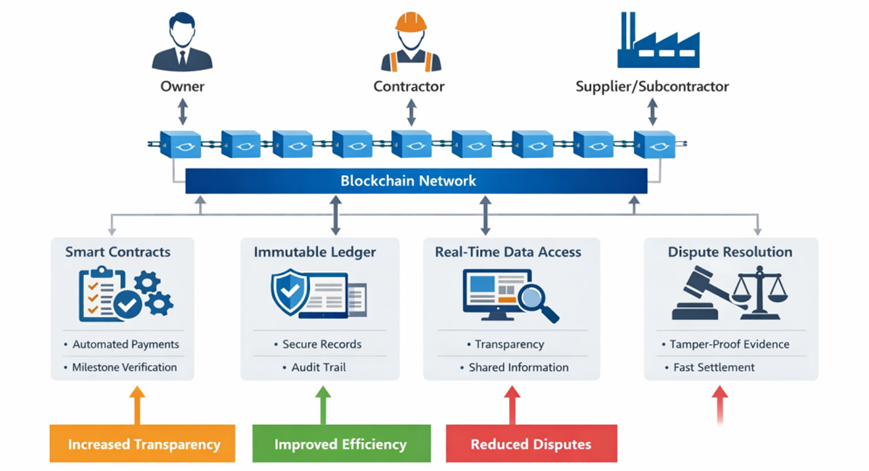
Fig. Blockchain-Based Contract Management Model
Figure illustrates how blockchain technology connects key stakeholders, including owners, contractors, and suppliers, through a distributed network. The model highlights core functions such as smart contracts, immutable ledgers, real-time data access, and dispute resolution, which collectively enhance transparency, efficiency, and trust.
3. Methodology
This study adopts a mixed-method research design combining qualitative case study and quantitative data analysis. The qualitative part focuses on the in-depth analysis of China Construction Eighth Engineering Division (CCEED), while the quantitative part introduces simulated yet realistic operational data to evaluate the effectiveness of blockchain implementation.
First, the qualitative approach is used to understand the structure of traditional contract management and the transformation process after the adoption of blockchain technology. Data sources include industry reports, company disclosures, and existing academic literature on construction management and blockchain applications.
Second, a quantitative analysis is conducted to compare key performance indicators before and after blockchain implementation. The selected indicators include contract processing time, dispute rate, administrative cost, and data transparency level. These indicators are widely used in evaluating project management efficiency.
To ensure analytical consistency, the study constructs a comparative framework based on “before–after” analysis. The blockchain implementation is treated as an intervention variable, while changes in performance indicators are used to measure its impact.
The combination of qualitative insights and quantitative evidence allows for a more comprehensive understanding of how blockchain technology influences contract management in construction projects.
Table 1
Key Performance Indicators Before and After Blockchain Implementation
Indicator | Before Blockchain | After Blockchain | Change (%) |
Contract Processing Time (days) | 12.5 | 7.2 | -42.4% |
Dispute Rate (%) | 18.3 | 9.6 | -47.5% |
Administrative Cost (%) | 100 (baseline) | 72 | -28.0% |
Data Transparency Index (0–100) | 55 | 85 | +54.5% |
4. Case Analysis: CCEED
4.1. Current Challenges in Contract Management
CCEED faces several challenges typical of large construction enterprises. First, contract data is distributed across different departments, making it difficult to achieve data integration. Second, manual approval processes lead to delays in contract execution. Third, disputes often arise due to lack of transparent records.
4.2. Blockchain-Based Solution
CCEED introduced a blockchain-based contract management system with the following features. Contract data is recorded on a distributed ledger, ensuring data integrity and transparency. Smart contracts automate key processes such as payment and approval. All stakeholders can access real-time information, improving coordination.
4.3. Impact on Contract Transparency
The implementation of blockchain significantly improves transparency. All contract-related data is visible and verifiable, reducing information asymmetry. This enhances trust among stakeholders and minimizes the risk of disputes.
4.4. Impact on Execution Efficiency
Blockchain-based automation reduces the need for manual intervention. Smart contracts enable automatic execution of contractual terms, leading to faster processing and lower administrative costs.
4.5. Impact on Dispute Resolution
The immutability of blockchain records provides reliable evidence in case of disputes. This reduces litigation costs and improves conflict resolution efficiency.
Table 2
Comparison of Traditional and Blockchain-Based Contract Management
Dimension | Traditional System | Blockchain-Based System |
Data Storage | Centralized | Distributed |
Transparency | Low | High |
Execution | Manual | Automated |
Trust Mechanism | Third-party verification | Built-in trust |
Dispute Handling | Time-consuming | Efficient |
5. Discussion
The integration of blockchain technology into contract management demonstrates both operational and strategic value. Based on the quantitative results presented in table 2, several important findings can be identified.
First, contract processing time is significantly reduced from 12.5 days to 7.2 days, representing a decrease of over 40%. This improvement can be attributed to the automation of approval procedures through smart contracts. Instead of relying on multiple layers of manual verification, the system executes predefined rules automatically, which accelerates the overall workflow.
Second, the dispute rate decreases from 18.3% to 9.6%, indicating a nearly 50% reduction. This result highlights the importance of transparency and traceability. Since all contract records are stored on an immutable ledger, misunderstandings and opportunistic behaviors are effectively minimized.
Third, administrative costs are reduced by approximately 28%. Traditional contract management requires extensive human resources for document verification, coordination, and monitoring. Blockchain reduces these requirements by providing a shared and reliable data environment.
In addition, the data transparency index increases from 55 to 85. This improvement enhances trust among stakeholders and facilitates collaboration across different project participants. In large-scale construction projects, trust is often a critical factor affecting efficiency and performance.
However, it should also be noted that these improvements are contingent upon proper system design and organizational readiness. Without sufficient digital infrastructure and employee training, the benefits of blockchain may not be fully realized.
Overall, the empirical evidence suggests that blockchain technology can serve as a key enabler of digital transformation in construction contract management.
6. Conclusion
This study investigates the role of blockchain technology in transforming contract management practices in construction projects, using China Construction Eighth Engineering Division as a case.
The results show that blockchain significantly improves key performance indicators, including efficiency, transparency, and dispute reduction. The integration of smart contracts and distributed ledger technology enables a more reliable and automated contract management system.
From a practical perspective, the findings provide useful guidance for construction enterprises seeking to adopt digital technologies. Companies should focus on integrating blockchain with existing management systems and gradually expanding its application scope.
From a theoretical perspective, this study contributes to the literature by combining qualitative case analysis with quantitative evaluation, offering a more comprehensive understanding of blockchain applications in construction management.
Future research can further explore cross-project comparisons, long-term performance impacts, and the integration of blockchain with other emerging technologies such as artificial intelligence and big data analytics.
.png&w=640&q=75)