.png&w=384&q=75)
1. Introduction
In the conditions of the global knowledge economy, the ability of an enterprise to maintain a stable competitive position is increasingly determined not by traditional cost advantages, but by its capacity to generate, absorb, and commercialize new knowledge. Innovative activity, understood as a complex of scientific, technological, organizational, financial, and marketing actions aimed at the implementation of innovations, has become the central instrument of long-term economic success. For enterprises operating in transition economies, including the Republic of Kazakhstan, the transformation of innovation potential into measurable competitive advantage is one of the most pressing managerial and strategic challenges.
The relevance of this topic is reinforced by the accelerating pace of technological change, the digitalization of business processes, and the expanding global value chains, all of which place innovation-active firms in a structurally privileged position. The aim of this article is to substantiate the role of innovative activity as a primary factor of enterprise competitiveness and to outline its key mechanisms of influence.
2. Theoretical Foundations
The theoretical understanding of innovation as a driver of competitiveness is rooted in the works of J. Schumpeter, who introduced the concept of "creative destruction" and demonstrated that economic growth originates from entrepreneurial innovation. Modern authors such as M. Porter, C. Christensen, and H. Chesbrough have refined this approach, distinguishing between sustaining and disruptive innovations and emphasizing the role of open innovation models. According to Porter's competitive strategy framework, innovation enables firms to simultaneously pursue cost leadership and differentiation, thereby breaking the traditional trade-off between these strategies.
Within the resource-based view, innovative capability is treated as a strategic, valuable, rare, and difficult-to-imitate resource. The dynamic capabilities approach further argues that the firm's ability to sense market changes, seize opportunities, and reconfigure its asset base is the ultimate source of sustained competitiveness. In all of these conceptions, innovative activity occupies a central, rather than auxiliary, position.
3. Classification of Innovative Activity
Contemporary management theory distinguishes several types of innovation that simultaneously shape an enterprise's competitive profile. Product innovation introduces new or significantly improved goods and services to the market and is most directly associated with revenue growth and brand equity. Process innovation modifies production and delivery technologies, generating cost reductions, quality improvement, and shorter time-to-market. Organizational innovation transforms the structure, business model, or managerial practices of the firm, while marketing innovation reshapes positioning, pricing, and customer engagement. In addition, modern literature increasingly highlights ecological and social innovations, which strengthen reputation capital and align the firm with sustainable development goals.
The cumulative effect of these types of innovation is what generates an integral competitive advantage. An enterprise that innovates only in products but ignores processes or business models tends to lose its leadership relatively quickly, since rivals can imitate isolated solutions more easily than systemic innovation portfolios.
4. Empirical Evidence and Industry Analysis
Empirical research consistently confirms a positive relationship between R&D intensity and the competitiveness of enterprises. Figure illustrates the correlation between R&D intensity (the share of R&D expenditures in revenue) and an integral competitiveness index for selected industries. The figure shows that knowledge-intensive sectors–pharmaceuticals, IT and software, and electronics–occupy the upper-right region of the chart and demonstrate the highest competitiveness scores, whereas low-tech industries lag significantly behind.
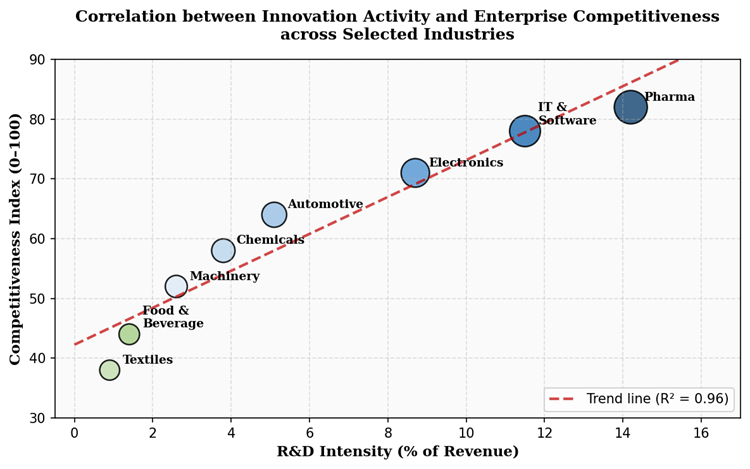
Fig. Correlation between R&D intensity and the integral competitiveness index across selected industries (compiled by the author based on OECD and Eurostat data, 2022–2024)
The trend line in Figure demonstrates a clear linear dependence between innovative effort and competitive position, with a coefficient of determination above 0.96. This result indicates that more than ninety per cent of the variation in industry-level competitiveness can be statistically explained by differences in innovation intensity, which strongly supports the central hypothesis of this study.
To deepen the analysis at the firm level, Table compares key performance indicators of innovative and non-innovative enterprises based on aggregated empirical data from a sample of medium- and large-sized firms operating in Kazakhstan, the Russian Federation, and the People's Republic of China during 2021–2024.
Table
Comparative performance of innovative and non-innovative enterprises (averaged values, 2021–2024) (compiled by the author based on the corporate reports of selected enterprises and statistics of the Bureau of National Statistics of the Republic of Kazakhstan.)
No. | Performance Indicator | Innovative Enterprises | Non-innovative Enterprises |
1 | Average annual revenue growth, % | 12.4 | 4.1 |
2 | Return on assets (ROA), % | 9.7 | 5.2 |
3 | Labor productivity, USD/employee | 78,500 | 42,300 |
4 | Market share dynamics, p.p. | +2.8 | −0.6 |
5 | Share of new products in revenue, % | 31.5 | 3.2 |
6 | Export share in total revenue, % | 28.6 | 9.4 |
The data presented in Table demonstrate that innovative enterprises consistently outperform their non-innovative counterparts across all analyzed dimensions. Average annual revenue growth is three times higher, labor productivity is almost twice as high, and the share of new products in total revenue exceeds thirty per cent – a level that simply cannot be reached by firms that abstain from systematic innovation. Particularly important is the dynamics of market share: while innovative companies expand their positions by 2.8 percentage points per year on average, non-innovative firms gradually lose ground.
5. Mechanisms Through which Innovation Strengthens Competitiveness
Innovative activity influences enterprise competitiveness through several interrelated mechanisms. First, it enables product differentiation, allowing firms to offer unique value propositions and command price premiums. Second, it reduces unit costs through process improvements, automation, and digital integration of supply chains. Third, innovation accelerates time-to-market, which is critical in industries with short product life cycles. Fourth, it stimulates the development of human capital: innovative firms invest more in training, attract higher-qualified specialists, and build organizational cultures oriented toward continuous learning.
In addition, innovation creates significant entry barriers in the form of patents, proprietary technologies, and reputational capital, while also expanding access to international markets and global value chains. In the context of digital transformation, the integration of artificial intelligence, big data analytics, and Industry 4.0 solutions further amplifies these effects, turning innovation from a discrete activity into a continuous capability embedded in the firm's strategic core.
6. Practical Implications for Kazakhstani Enterprises
For enterprises operating in the Republic of Kazakhstan, the transition to an innovation-driven competitiveness model requires coordinated efforts at three levels. At the strategic level, top management should formalize innovation as a corporate priority, allocate dedicated budgets, and establish key performance indicators related to innovative output. At the operational level, it is necessary to introduce structured innovation management systems, including idea management platforms, R&D project portfolios, and partnerships with universities and research centers. At the institutional level, active use of state support instruments–innovation grants, technology parks, and industry development programs–can substantially reduce the financial and informational barriers to innovation.
Particular attention should be devoted to the digital transformation of traditional sectors of the Kazakhstani economy, including mining, agribusiness, and logistics, where the productivity gap with leading economies remains significant and where targeted innovation investments can yield disproportionately high returns.
7. Conclusion
The analysis presented in this article confirms that innovative activity functions as a primary driver of enterprise competitiveness in the modern economy. The empirical evidence demonstrates a strong positive relationship between R&D intensity and competitive performance at the industry level, while firm-level comparisons reveal substantial advantages of innovative enterprises in terms of growth, productivity, profitability, and market expansion. Innovation acts simultaneously as a source of differentiation, a tool for cost reduction, and a foundation for long-term strategic resilience.
For enterprises in transition economies such as Kazakhstan, the formation of systemic innovation management practices, integrated with human capital development and digital transformation, represents the most promising path toward sustainable competitive leadership. Further research may focus on quantitative modeling of the relationship between specific types of innovation and competitiveness indicators in the Kazakhstani industrial sector, as well as on the role of public-private partnerships in stimulating corporate innovation.
.png&w=640&q=75)